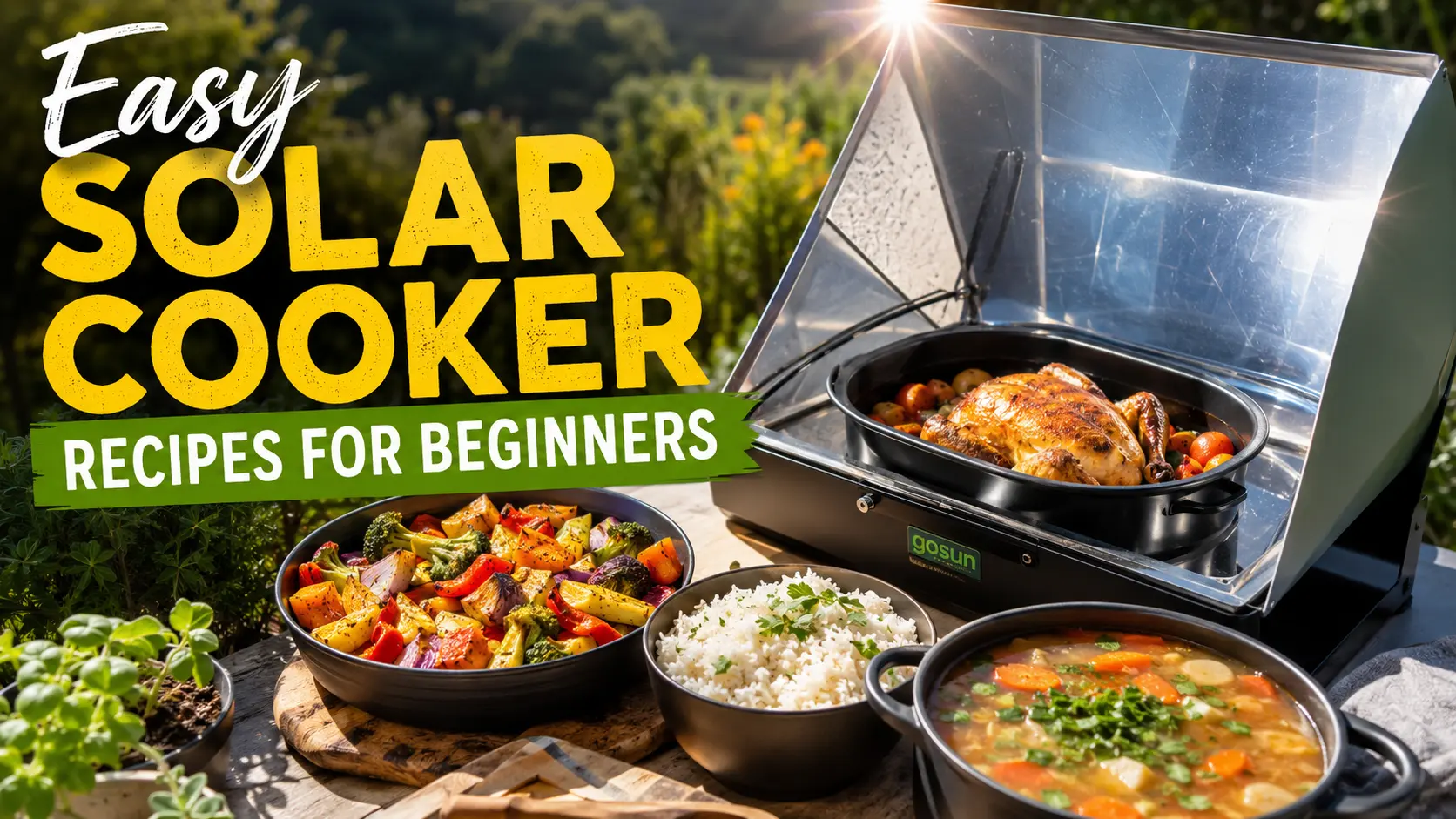
Can you cook real meals with a solar cooker? Yes—discovering solar cooker recipes for beginners is a fantastic way to prepare a wide range of simple, tasty dishes using only sunlight. These easy recipes are designed to be safe, delicious, and reliable, even if you are just starting out.
A Note from Me: I still remember the first time I set up a solar cooker in my backyard. I was incredibly skeptical. I kept checking the sky, wondering if a stray cloud would ruin my dinner, and honestly, I half-expected to end up ordering takeout. But a few hours later, when I lifted the lid off a pot of perfectly fluffy rice cooked entirely by the sun, I was hooked. It felt like a magic trick, but it’s just pure, beautiful science. If you’re feeling a little intimidated, don’t worry—we’ve all been there, and this guide is here to show you just how simple (and rewarding) it can be!
Solar cooking works best for slow-cooked foods like rice, vegetables, stews, and desserts. With the right setup and good sunlight, you can cook healthy meals without gas or electricity.
Table of Contents
☀️ What Makes a Recipe “Solar Cooker Friendly”?
Before you start, it helps to understand what works best in a solar cooker. Unlike a conventional gas or electric stove that delivers intense, direct heat to the bottom of a pan, solar cookers rely on ambient, radiant heat trapped within an insulated space or focused by reflective panels. This creates a gentle cooking environment remarkably similar to a kitchen crockpot or slow cooker.
Because the temperature rises gradually, certain types of food thrive in this environment while others require modification. For the best experience as a beginner, look for recipes that match these criteria:
- Slow cooking is ideal (like a crockpot)
- Moist foods cook better (soups, stews, rice)
- Small pieces cook faster
- Minimal stirring required
👉 If you’re new, read: Solar Cooker Basics
👉 Improve results: How to Improve Solar Cooker Efficiency
👉 Stay safe: Solar Cooker Safety Tips
The Chemistry of Low-Temperature Thermal Breakdown
Cooking in a solar thermal collector alters how moisture and flavor compounds behave compared to high-heat stovetop cooking. Traditional kitchen stoves rely on active convection currents caused by boiling liquids, which causes significant water loss through evaporation. In a sealed solar chamber, humidity remains near 100%. Water molecules evaporate from the food, condense on the inner surface of the dark lid, and continuously rain back down onto the ingredients.
Because moisture is completely trapped inside the pot, vegetables and meats cook in their own natural juices. Complex carbohydrates in root vegetables break down slowly into sweet simple sugars without scorching, and tough collagen in meats hydrolyzes gently into gelatin between 71 degree C to 82 degree C. This slow thermal breakdown produces tender textures and concentrated, natural flavors without requiring added oils, fats, or excess water.
🍚 1. Easy Solar Cooker Rice
Ingredients:
- 1 cup rice
- 2 cups water
- Pinch of salt
Instructions:
- Add all ingredients into a dark pot with lid
- Place inside your solar cooker
- Cook for 1.5 to 2 hours in strong sunlight
Tips:
- Do not open lid frequently
- Use a black pot for better heat absorption
🥕 2. Simple Solar Steamed Vegetables
Ingredients:
- Carrots, broccoli, potatoes (chopped)
- 2–3 tablespoons water
- Salt (optional)
Instructions:
- Place vegetables in pot
- Add a little water
- Cook for 1.5 to 2.5 hours
Tips:
- Cut vegetables smaller for faster cooking
- Works great in box and panel cookers
The Best Part of Solar Cooking: One of my favorite things about using the sun to cook is the freedom it gives you. Unlike cooking on a traditional stove where you’re tethered to the kitchen out of fear something will burn or boil over, solar cooking is incredibly forgiving. You can set up your pot, go read a book, work in the garden, or hang out with your family, and let the sun do all the heavy lifting. Plus, there is nothing quite like the rich, deep flavors that develop from this gentle, slow-cooking process.
🍲 3. Beginner Solar Stew
Ingredients:
- Mixed vegetables
- Beans or lentils
- Water or broth
- Seasoning
Instructions:
- Combine everything in a pot
- Place in cooker
- Cook for 2 to 4 hours
Tips:
- Perfect for beginners
- Very forgiving recipe
🍗 4. Solar Cooker Chicken (Basic)
Ingredients:
- Chicken pieces
- Salt, pepper, seasoning
- Small amount of water or marinade
Instructions:
- Place chicken in covered pot
- Cook for 3 to 4 hours
- Ensure internal temperature is fully cooked
Safety Tip:
👉 Always ensure chicken is fully cooked before eating
👉 Learn more: Can You Cook Meat in a Solar Cooker?
Optimizing Heat Absorption: Emissivity and Thermal Mass
Achieving predictable cooking times with solar recipes depends heavily on selecting cookware with optimal thermal properties:
Surface Emissivity: Reflective stainless steel or bare aluminum cookware reflects up to 80% of incoming light rays away from your food. Lightweight enamelware or thin aluminum coated with matte black high-temperature paint absorbs up to 90% of solar irradiance, converting visible light into longwave thermal energy efficiently.
Thermal Mass vs. Heat Up Speed: Heavy cast iron pots store large amounts of heat once hot, but they demand a substantial portion of the solar cooker’s early energy budget just to reach thermal equilibrium. Thin-walled dark metal pots allow solar energy to pass directly into the liquid and food, reducing warm-up times by 30 to 45 minutes.
🍎 5. Baked Apples (Easy Dessert)
Ingredients:
- Apples
- Honey or sugar
- Cinnamon
Instructions:
- Core apples and add filling
- Place in pot
- Cook for 1.5 to 2 hours
🍞 Baking Mechanics: Solar Bread and Cake Adaptations
While braising stews and steaming grains are straightforward, baking breads and cakes in a solar cooker requires adjusting liquid ratios to account for zero evaporation:
Reduce Liquid Ratios: When converting conventional baking recipes for a box or panel solar cooker, reduce total liquid inputs (water, milk, or broth) by 10% to 15%. Because moisture cannot escape through a sealed lid, standard batter volumes can result in soggy centers if liquid levels are too high.
Dark Muffin Tins and Dark Glass: Bake rolls, muffins, or small cakes using dark, non-stick muffin tins or dark glass baking dishes. Smaller, individual portions absorb ambient solar heat faster than a single large bread loaf, guaranteeing even baking without raw centers.
⏱️ How Long Does Solar Cooking Take?
| Food Type | Time (Approx.) |
|---|---|
| Rice | 1.5–2 hours |
| Vegetables | 1.5–2.5 hours |
| Stew | 2–4 hours |
| Chicken | 3–4 hours |
| Dessert | 1.5–2 hours |
👉 Cooking time depends on sunlight intensity and cooker type.
🔥 Tips for Better Results
- Use a black or dark pot
- Keep lid closed as much as possible
- Adjust cooker toward the sun every 1–2 hours
- Cook between 10 AM – 2 PM for best results
⚠️ Safety Tips (Important)
- Always cook meat thoroughly
- Avoid opening the cooker too often
- Use proper containers with lids
- Keep food covered to maintain heat
👉 Read full guide: Solar Cooker Safety Tips
🚀 Final Thoughts
Solar cooking is simple, eco-friendly, and a wonderful way to connect with nature. Don’t feel pressured to make a gourmet, multi-course meal on day one. Start small with something foolproof like the rice or the baked apples, get a feel for how your cooker handles the sun, and build your confidence from there. Once you get the hang of it, you’ll find yourself looking at sunny days as a free pass to an outdoor culinary adve
👉 Next step: Explore different Types of Solar Cookers
👉 Want better results? Check Best Solar Cooker
❓ FAQs
What is the easiest food to cook in a solar cooker?
Grains (like white rice or quinoa) and chopped root vegetables are the easiest and most reliable foods for beginners. They are highly tolerant of slight temperature fluctuations and do not carry the food safety risks associated with undercooked meats.
Can beginners cook meat in a solar cooker?
Yes, but you must be mindful of food safety guidelines. Bacteria thrive between $40^\circ\text{F}$ and $140^\circ\text{F}$ ($4.4^\circ\text{C}$ to $60^\circ\text{C}$). Your solar cooker needs to get your meat past this “danger zone” quickly and maintain a safe holding temperature. Always use a digital food thermometer to verify that poultry reaches an internal temperature of $165^\circ\text{F}$ ($74^\circ\text{C}$).
Do I need strong, blazing sunlight?
Not at all! Solar cooking relies on the intensity of the sun’s UV rays, not the temperature of the outside air. You can successfully cook a hot meal on a freezing, crisp winter day as long as the skies are completely clear and your cooker is well-insulated.
What happens if a cloud blocks the sun while I’m cooking?
Brief, passing clouds are usually not an issue because high-quality pots and insulated box cookers retain residual heat well. However, if the sky becomes completely overcast for more than 20–30 minutes, your cooking process will stall. If you are cooking meat and the sun disappears completely, it is best to transfer the pot inside to a conventional stove to finish the meal safely.
Do I need special pots for solar cooking?
You don’t need expensive specialty gear, but you do need thin, dark, matte-finished metal pots with lids. Thick cast iron takes too long to heat up, and shiny aluminum or stainless steel pots reflect the sun’s rays away rather than absorbing them. Simple, cheap, black enamel camping cookware works best!
Have more questions about solar cooking?
Visit our Solar Cooker FAQ: 50 Frequently Asked Questions for expert answers on choosing a solar cooker, cooking times, food safety, recipes, maintenance, and troubleshooting. It’s a great resource for both beginners and experienced solar cooking enthusiasts.