Types of Solar Cookers for Beginners Explained
This guide explains the main types of solar cookers for beginners, including box, panel, and tube solar cookers, and how to choose the best one.
Solar cooking is a simple and sustainable way to prepare food using sunlight. For beginners, choosing the right type of solar cooker is important because different designs vary in ease of use, cooking speed, and safety.
This guide explains the main types of solar cookers suitable for beginners and helps you understand which option is best based on your needs.
Why Choosing the Right Solar Cooker Matters
Not all solar cookers are equally beginner-friendly. Some designs require frequent adjustment, careful handling, or experience to use effectively.
A beginner-friendly solar cooker should be:
- Easy to set up
- Safe to operate
- Stable in temperature
- Suitable for simple cooking
- Affordable or easy to build
Before choosing a cooker, it helps to understand how solar cooking works and how sunlight is converted into heat for cooking.
Starting with the right type makes solar cooking more practical and enjoyable.
If you are looking for recommendations, check out our guide on the best solar cookers for beginners to find the most suitable option for your needs.
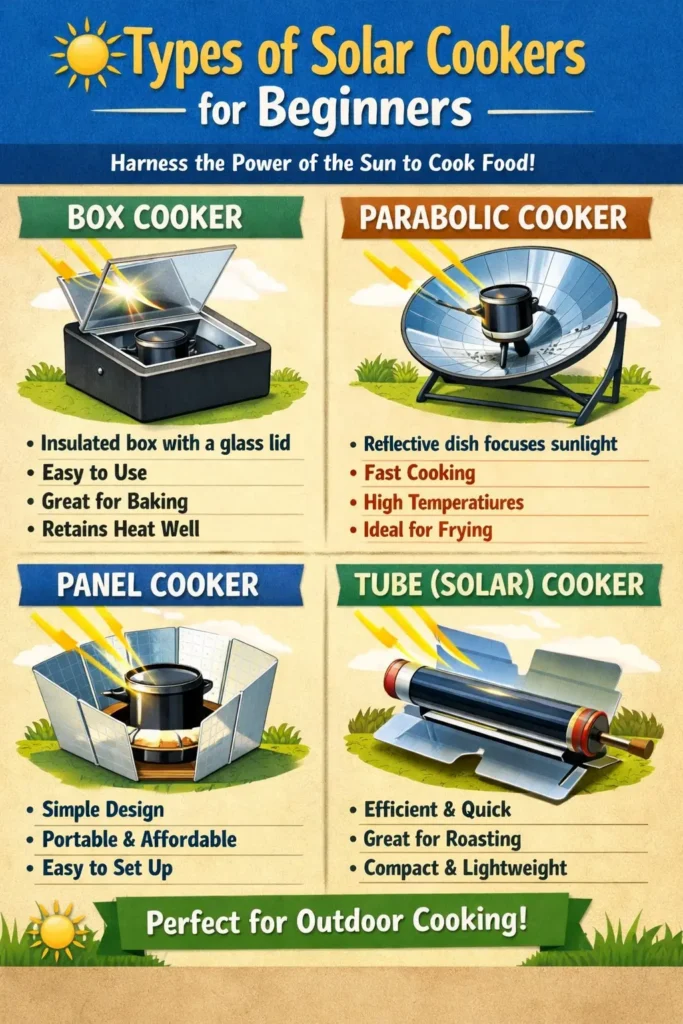
1. Box Solar Cookers (Best for Beginners)
Box solar cookers are widely considered the best option for beginners.
They use an insulated box with a transparent cover to trap heat, similar to an oven.
Advantages
- Easy to use with minimal adjustment
- Provides stable and consistent temperatures
- Safe compared to high-heat designs
- Suitable for a wide range of foods
Typical Uses
- Cooking rice and grains
- Preparing vegetables and stews
- Baking simple dishes
Limitations
- Cooking is slower compared to other types
- Requires steady sunlight for best performance
For most beginners, a box solar cooker is the most reliable starting point.
2. Panel Solar Cookers (Simple and Portable)
Panel solar cookers use reflective panels to direct sunlight onto a cooking pot.
They are one of the simplest types of solar cookers and are often used in DIY projects.
Advantages
- Lightweight and portable
- Easy to build using basic materials
- Low cost
- Good for educational use
Typical Uses
- Basic cooking tasks
- School projects
- Outdoor or emergency cooking
Limitations
- Lower cooking temperatures
- Longer cooking times
- Requires occasional adjustment
Panel cookers are ideal for beginners who want a simple and affordable option.
3. Parabolic Solar Cookers (Advanced Option)
Parabolic solar cookers use curved reflective surfaces to focus sunlight onto a single point, producing high temperatures.
Advantages
- Can reach very high temperatures
- Faster cooking compared to other types
- Suitable for frying or grilling
Limitations
- Requires precise alignment with sunlight
- Needs careful handling for safety
- Not ideal for beginners
While powerful, parabolic cookers are generally better suited for users with some experience.
Comparison of Solar Cooker Types
| Type | Ease of Use | Temperature | Best For |
|---|---|---|---|
| Box Solar Cooker | Easy | Medium | Beginners, steady cooking |
| Panel Solar Cooker | Very easy | Low–Medium | DIY and portability |
| Parabolic Solar Cooker | Moderate–Difficult | High | Fast cooking |
Which Solar Cooker Should Beginners Choose?
For most beginners:
- Box solar cookers are the best all-around choice
- Panel solar cookers are great for simple and portable use
- Parabolic cookers are better explored after gaining experience
Choosing a simple and stable design helps you learn solar cooking more effectively.
Pros and Cons of Each Type
| Type | Pros | Cons |
|---|---|---|
| Box | Easy, safe | Slower |
| Panel | Cheap | Less efficient |
| Tube | Fast | Expensive |
Cooking Time Comparison
- Box cooker: 2–4 hours
- Panel cooker: 2–3 hours
- Tube cooker: 1–2 hours
Real-World Example
For example:
- A student working on a school project may choose a panel cooker because it is easy to build.
- A beginner cooking daily meals may prefer a box cooker for its consistent performance.
- Someone looking for faster cooking may explore a parabolic cooker, but with caution.
When Solar Cooking Works Best
Solar cookers perform best when:
- There is strong, direct sunlight
- Cooking time is flexible
- Food does not require constant stirring
Examples of suitable foods include:
- Rice and grains
- Beans and lentils
- Vegetables
- Soups and stews
Final Thoughts
Understanding the different types of solar cookers helps beginners choose the right starting point. For most people, a simple and reliable design such as a box or panel cooker provides the best introduction to solar cooking.
As you gain experience, you can explore more advanced designs and improve your cooking efficiency.
Frequently Asked Questions
What is the easiest solar cooker for beginners?
Box solar cookers are the easiest because they are simple, safe, and require minimal adjustment.
Can solar cookers work on cloudy days?
They work best in direct sunlight but can still function slowly under light clouds.
What food can you cook in a solar cooker?
Rice, vegetables, soups, and even baked goods