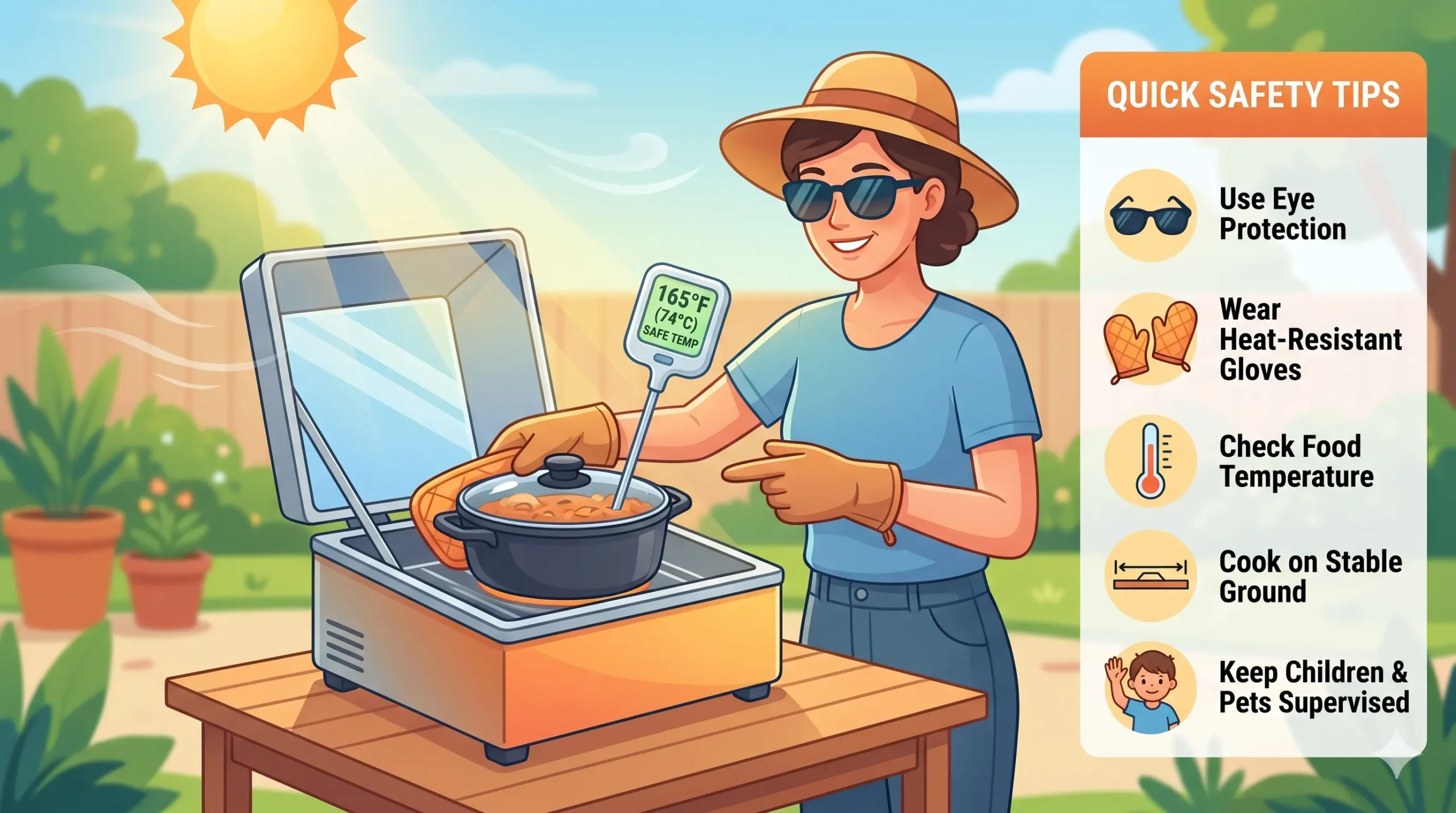
Discovering how to use a solar cooker safely helps protect your eyes, prevents accidental heat burns, and ensures your meals cook thoroughly under the sun. Though solar cooking is straightforward and flame-free, proper handling is key to a smooth experience.
Many beginners are excited to try solar cooking, but an important question comes up first: is a solar cooker safe to use?
This article is part of our complete Solar Cooker Guide for beginners.
Table of Contents
A Quick Reality Check
When I first started solar cooking, I’ll admit I was a bit too casual about it. Because there’s no roaring flame or glowing red coil, it’s easy to forget just how much power the sun actually packs. I learned my lesson the hard way after reaching for a black pot with my bare hands, thinking it “couldn’t be that hot”—only to find it was every bit as scorching as a pot pulled from a 180°C oven. Now, I treat my solar cooker with the same respect I give my kitchen stove. It’s a gentle way to cook, but the physics behind it are very real.
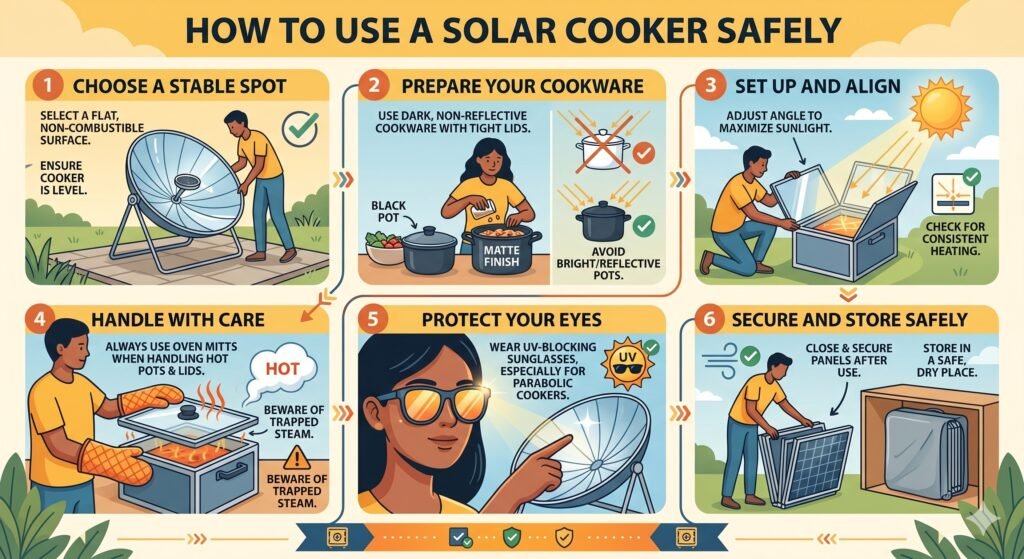
The good news is that solar cookers are generally very safe when used correctly. However, because they use concentrated sunlight and can reach high temperatures, proper handling is essential.
This guide explains important solar cooker safety tips to help you cook confidently and responsibly.
1. Never Look Directly at Reflected Sunlight
Solar cookers use reflective panels to concentrate sunlight. These surfaces can be very bright and may harm your eyes.
Safety tips:
- Avoid staring at reflective foil or mirrors.
- Adjust reflectors while standing slightly to the side.
- Supervise children closely around reflective panels.
If using a parabolic solar cooker, this is especially important because it concentrates sunlight more intensely.
The Physics of Solar Glare and UV Ocular Protection
The optical hazard associated with solar cookers—particularly parabolic dishes and highly polished specular reflectors—stems from focused solar radiance. While diffuse ambient daylight is harmless, parabolic mirrors converge scattered rays into a concentrated focal point. Staring into this reflected beam delivers high concentrations of Ultraviolet A (UVA) and Ultraviolet B (UVB) light directly to the retina, which can lead to photokeratitis (temporary cornea inflammation, often referred to as “snow blindness”) or solar retinopathy.
To mitigate optical strain and potential eye damage during setup and adjustment, always wear UV400-rated, polarized sunglasses. Polarization selectively filters out horizontally polarized light waves bouncing off reflective aluminum, stainless steel, or mirrored film, dramatically reducing glare while allowing you to position reflectors safely without squinting or straining your vision.
2. Use Heat-Resistant Cookware
Solar cookers can reach temperatures between 120°C and 200°C depending on the model and sunlight conditions.
Always use:
- Dark-colored pots
- Heat-resistant glass or metal cookware
- Tight-fitting lids
Avoid plastic containers or thin materials that can melt.
3. Handle Cookware Carefully
Even though solar cooking feels gentle, the pot inside can become very hot.
Before removing food:
- Use oven mitts or heat-resistant gloves.
- Open the cooker slowly to release trapped heat.
- Avoid leaning directly over the cooking chamber.
Treat a solar cooker like you would a conventional oven.
4. Place the Cooker on a Stable Surface
Always set up your solar cooker:
- On flat, stable ground
- Away from foot traffic
- In an area free from wind interference
Strong wind can knock over lightweight solar cookers, especially DIY panel models.
You can place small weights around the base for added stability.
5. Monitor Children and Pets
Solar cookers can look harmless, but:
- Reflective panels may attract children.
- Hot cookware can cause burns.
- Pets may bump into the setup.
Never leave solar cooking equipment unattended in areas where children or animals are active.
6. Avoid Cooking After Sunset
Solar cookers rely on direct sunlight. As sunlight weakens:
- Temperatures drop
- Food may not cook thoroughly
- Bacterial growth risk increases
Plan meals so cooking finishes before late afternoon.
For estimated cooking times, see our guide on How Long Does a Solar Cooker Take to Cook Food.
Microbiological Guidelines and the Food Safety Danger Zone
From a culinary safety perspective, maintaining strict control over internal food temperatures is essential when cooking with slow, thermal solar energy. Food safety authorities classify temperatures between 40°F and 140°F (4°C to 60°C) as the “Danger Zone”—the thermal range where foodborne pathogens like Salmonella, E. coli, and Listeria multiply exponentially.
Because solar cookers build heat incrementally, food passes through this danger zone during the initial warm-up phase. To maintain food safety:
- Minimum Internal Thresholds: Ensure poultry, minced meats, and dense stews reach a minimum internal temperature of 165°F (74°C) verified by a digital probe thermometer.
- The 2-Hour Window: If thick cloud cover drops the chamber temperature and food remains below 140°F (60°C) for more than two consecutive hours, immediately transfer the cookware to a conventional gas or electric stove to complete the cooking cycle.
- Pasteurization Metrics: Water pasteurization occurs at 149°F (65°C)maintained for at least 6 minutes. Utilizing a Water Pasteurization Indicator (WAPI)—a small wax-filled capsule—provides visual proof that water or liquid broth has reached safe pasteurization thresholds.
7. Keep the Reflective Surfaces Clean
Dirty reflectors reduce efficiency and may cause uneven heating.
To maintain safety and performance:
- Wipe reflective surfaces gently with a soft cloth
- Avoid scratching mirror finishes
- Store the cooker indoors when not in use
8. Be Cautious with Parabolic Solar Cookers
Parabolic solar cookers can reach very high temperatures very quickly.
Extra safety considerations:
- Never place your hand at the focal point
- Adjust alignment carefully
- Do not leave unattended
If you are new to solar cooking, a box solar cooker is generally safer and easier to manage. Learn more in our article on Types of Solar Cookers.
9. Cook Food Thoroughly
Although solar cooking is reliable, always ensure food is properly cooked.
- Use a food thermometer when possible.
- Reheat if unsure.
- Avoid partially cooked meats.
You can also explore suitable beginner dishes in What Foods Can You Cook in a Solar Cooker.
10. Store Equipment Safely
After cooking:
- Allow the cooker to cool fully.
- Close reflectors carefully.
- Store indoors to protect from rain and wind damage.
Proper storage increases the lifespan of your solar cooker and maintains safe operation.
Are Solar Cookers Dangerous?
When used responsibly, solar cookers are not dangerous. They do not use gas, electricity, or open flames. In fact, many people find them safer than traditional stoves because:
- There is no flame.
- There is no fuel combustion.
- There is minimal risk of fire when properly positioned.
The key is awareness and careful handling.
🧱 Structural Stability, Thermal Expansion, and Steam Venting
Beyond glare and food temperature monitoring, physical handling of high-thermal-mass solar enclosures requires basic mechanical awareness:
- Differential Thermal Expansion: Glass lids and double-walled glazed windows expand as internal chamber temperatures rise toward 300°F (149°C). Avoid spraying cold water or placing wet cloths on hot glass lids, as rapid thermal shock can cause immediate stress fractures or shattering.
- Steam Pressure Control: Because dark enamel cookware traps moisture tightly inside an insulated solar chamber, heavy steam builds up beneath the lid. When checking meal progress, always lift the far side of the lid first so steam vents away from your face and hands, avoiding severe vapor burns.
- Wind Mitigation Mechanics: Solar cookers—especially lightweight panel designs—act like solar sails under strong gusts. Anchor your cooker using sandbags across the lower frame or position it in a wind-sheltered corner. Keeping the unit stable prevents accidental tipping, hot liquid spills, and structural damage to reflective panels.
My Personal Safety Routine
Over the years, I’ve developed a small “solar toolkit” that stays by the back door. It includes a sturdy pair of oven mitts and a pair of polarized sunglasses. It might feel a bit strange to put on sunglasses just to check on your lunch, but when you’re working with reflective panels, the glare can be blinding. Taking that extra second to protect your eyes and hands makes the whole experience much more relaxing. Solar cooking should be fun, and staying safe is the best way to keep it that way.
Final Thoughts
Solar cooking is a safe, sustainable, and enjoyable way to prepare meals using sunlight. By following these solar cooker safety tips, you can reduce risk and maximize your cooking experience.
If you’re new to solar cooking, start with simple recipes and practice proper setup. With the right approach, solar cooking is both safe and effective.
What are the basic solar cooker safety tips?
Always use your solar cooker in an open, sunny area, wear protective gloves when handling hot cookware, and avoid looking directly at reflected sunlight to prevent eye injury.
Can a solar cooker cause burns?
Yes, solar cookers can reach high temperatures (over 100°C). Always handle pots and lids with heat-resistant gloves to avoid burns.
Is it safe to look at a solar cooker while cooking?
Avoid looking directly at reflective surfaces such as mirrors or aluminum panels, as they can reflect intense sunlight and harm your eyes.
How do I safely position a solar cooker?
Place your solar cooker on a stable, flat surface facing direct sunlight. Adjust it periodically to follow the sun for efficient and safe cooking.
What should I wear when using a solar cooker?
Wear sunglasses to protect your eyes and use heat-resistant gloves when handling hot pots or adjusting the cooker.
Can children use a solar cooker safely?
Children can use a solar cooker under adult supervision. Ensure they understand basic safety rules like avoiding hot surfaces and bright reflections.
What materials are safe to use in a solar cooker?
Use dark-colored, heat-absorbing cookware like black pots or pans. Avoid plastic or materials that can melt under high heat.
How do I prevent accidents when using a solar cooker?
Keep the cooking area clear, avoid touching hot surfaces directly, and never leave the cooker unattended for long periods.