One of the most common beginner questions is: what temperature can a solar cooker reach? Many people assume solar cookers only produce low heat, but in reality, they can reach surprisingly high temperatures under the right conditions.
Many people assume solar cookers only produce mild heat. In reality, depending on the design and sunlight intensity, solar cookers can reach surprisingly high temperatures — enough to boil water, bake bread, and cook meat safely.
Understanding temperature ranges helps you choose the right type of solar cooker and cook food properly.
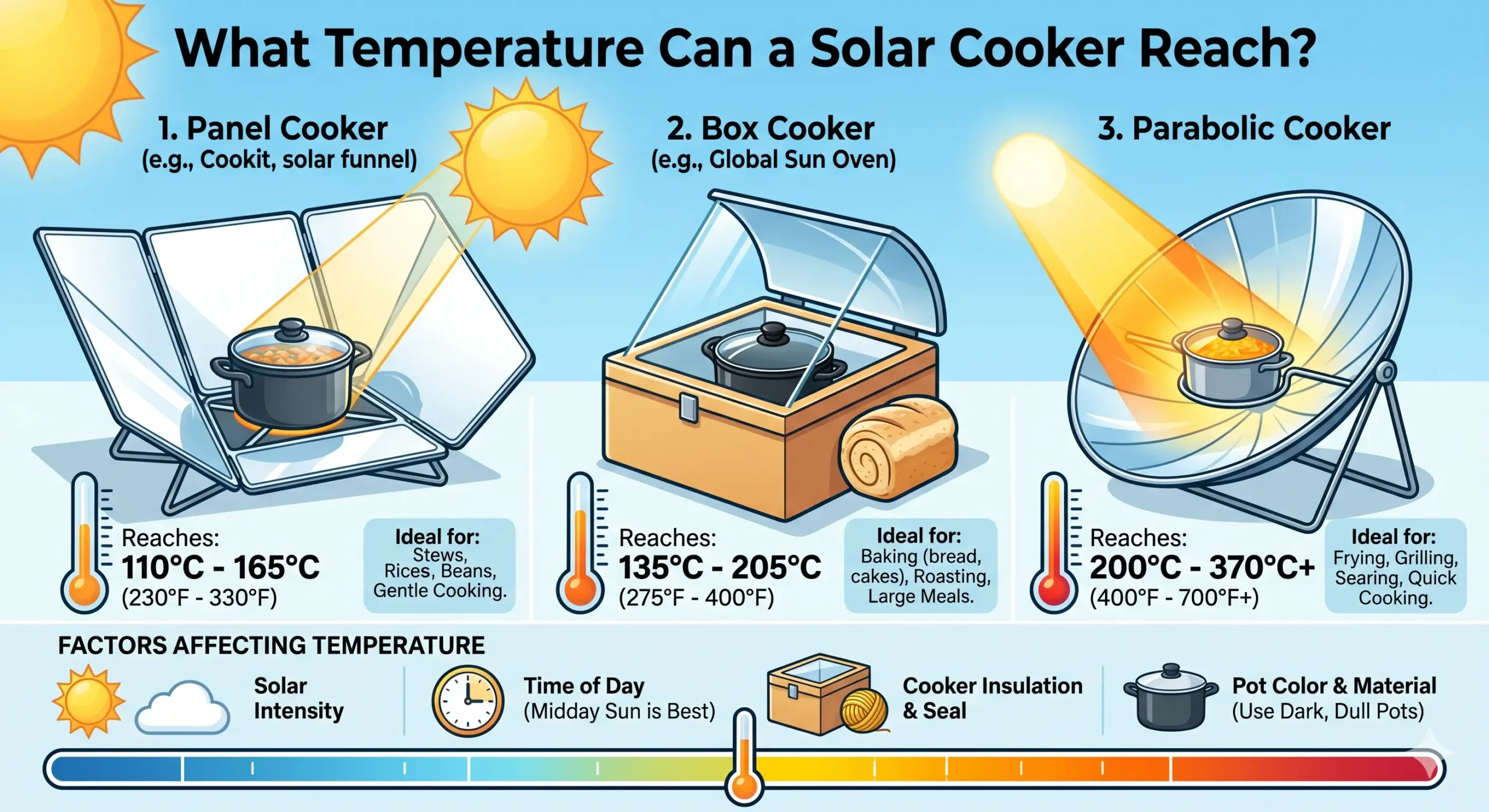
Table of Contents
An Intro to the Reality of Solar Heat
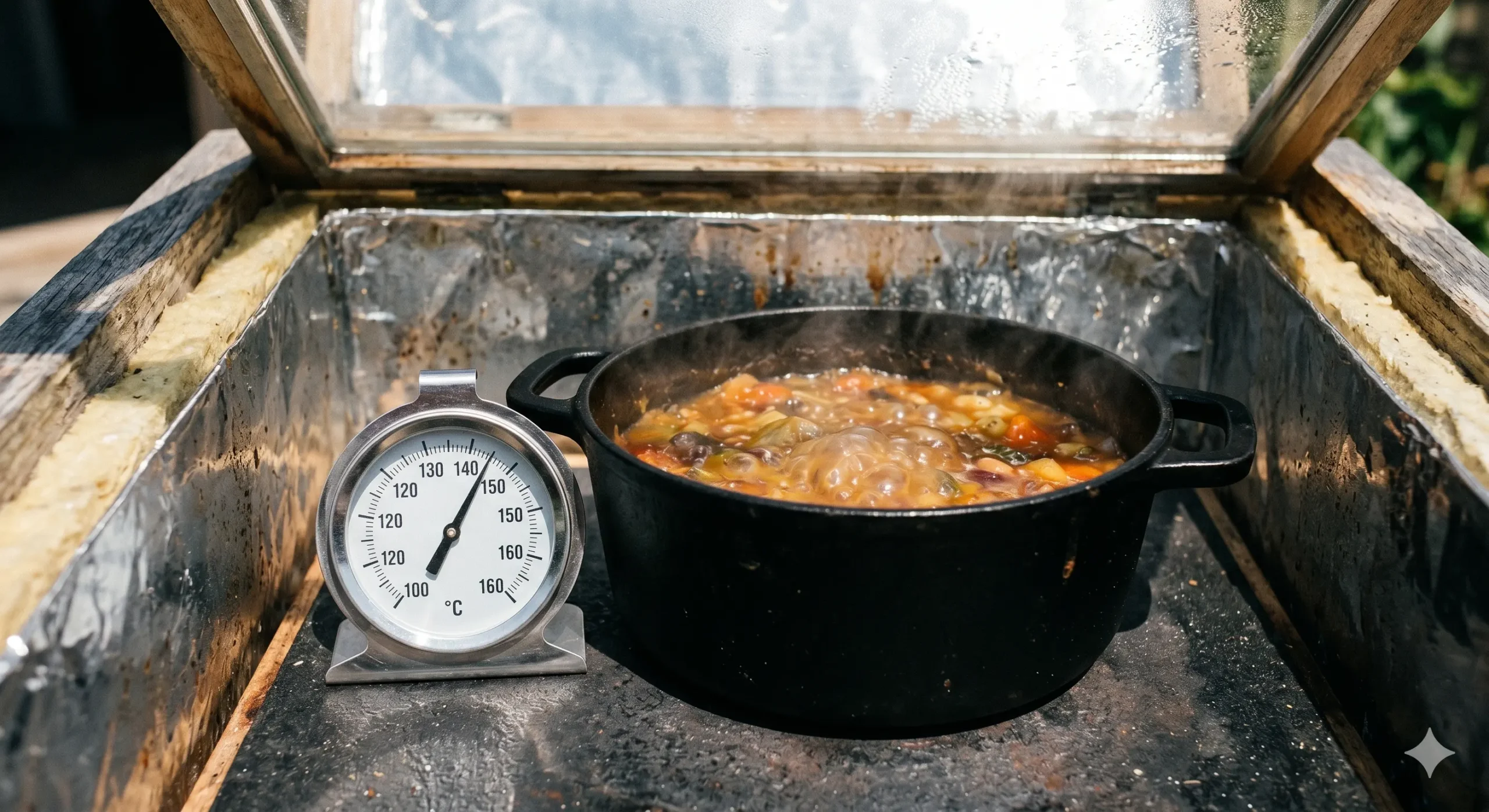
When I first started experimenting with solar ovens, I shared the exact same skepticism. It’s hard to believe that a box made of simple materials sitting in your backyard can get hot enough to cook a family meal. But the first time I measured the internal temperature of a homemade cardboard box cooker and watched the thermometer climb right past the100 Degree Celsius mark, I was hooked. There is a distinct, quiet thrill when you realize you’re boiling water or baking bread using absolutely zero electricity or gas—just pure, free sunlight.
Average Temperature Range of Solar Cookers
Under strong direct sunlight (around midday in clear weather), most solar cookers reach:
- 100°C to 150°C (212°F–300°F) for box and panel cookers
- 150°C to 200°C (300°F–400°F) for well-insulated box cookers
- 200°C to 300°C+ (400°F–570°F+) for parabolic cookers
These temperatures are sufficient for:
- Cooking rice
- Boiling water
- Baking bread
- Slow-cooking vegetables
- Cooking poultry and meat
How Do You Know If Your Cooker Is Hitting the Mark?
Knowing these temperature ranges is one thing, but tracking them in your backyard is another. Because solar cooking relies entirely on moving sunlight and changing weather, you can’t just set a dial and walk away like a conventional oven. To take the guesswork out of your cooking—and to ensure your meals are hovering safely in that $120^{\circ}\text{C}$ to $150^{\circ}\text{C}$ sweet spot—you need a tool that can read temperatures through a glass lid or a sealed oven frame. If you want to know which styles work best under the sun without breaking the bank, head over to our comprehensive guide on how to choose the correct thermometer for your specific solar setup.
Why Temperature Varies
Solar cooking temperature depends on several factors:
1️⃣ Type of Solar Cooker
Box Solar Cookers
- Most common and beginner-friendly
- Retain heat using insulation and glass cover
- Typically reach 120–160°C
Panel Solar Cookers
- Lightweight and simple design
- Lower heat concentration
- Usually 100–140°C
Parabolic Solar Cookers
- High-performance reflectors
- Directly focus sunlight to a single point
- Can exceed 250°C
If you’re unsure which design suits you best, see our guide on Types of Solar Cookers.
2️⃣ Sunlight Intensity
Solar cookers perform best under:
- Clear skies
- Low humidity
- Strong midday sun (10:30 AM – 2:30 PM)
Cloud cover can reduce temperature significantly.
3️⃣ Proper Alignment
A solar cooker must face direct sunlight.
Real-world tip:
Even a 10–15° misalignment can noticeably reduce temperature. Re-adjust every 30–60 minutes for optimal heating.
My Hands-On Alignment Tip:
If you want to keep your temperatures high without constantly guessing, try using the “shadow trick.” Look at the shadow thrown by your cooker’s frame or a small stick attached to the side. When the shadow is at its absolute shortest, your cooker is perfectly squared up with the sun. Making it a habit to do a quick adjustment every 45 minutes or so during a cook keeps the heat steady and prevents those frustrating temperature drops.
4️⃣ Cookware Used
Using:
- Dark, matte pots
- Tight lids
- Thin glass cover (for box cookers)
Improves heat retention and overall temperature.
Is 150°C Enough to Cook Food Safely?
Yes.
Many foods cook safely well below 200°C.
For example:
- Water boils at 100°C
- Rice cooks fully at 100°C
- Vegetables soften at 85–100°C
- Poultry is safe at internal temp of 75°C
Solar cookers operate like slow cookers. Even at moderate temperatures, food can cook thoroughly with time.
The Slow-Cooker Magic
In practice, you quickly learn that solar cooking is less like a fiery stovetop and more like a dependable countertop slow cooker. You don’t need raging, blistering heat to get incredible results. I’ve found that letting a meal simmer away at a steady $120\text{°C}$ to $140\text{°C}$ produces some of the tenderest meats and most flavorful stews you can imagine, all while being incredibly forgiving—it’s virtually impossible to burn your food this way.
For timing estimates, read How Long Does a Solar Cooker Take to Cook Food.
Can a Solar Cooker Boil Water?
Yes.
Even a standard box solar cooker can bring water to boiling point (100°C) under good sunlight.
Boiling water demonstrates the cooker’s capability for:
- Cooking grains
- Making soup
- Preparing hot beverages
A parabolic solar cooker can boil water much faster than a box cooker.
Solar Cooker Temperature vs Conventional Oven
| Feature | Solar Cooker | Electric Oven |
|---|---|---|
| Typical Max Temperature | 120–200°C | 230–260°C |
| Heat Source | Sunlight | Electricity |
| Cooking Speed | Slower | Faster |
| Fuel Cost | Free | Continuous cost |
Solar cookers may not match conventional ovens in peak temperature, but they are highly effective for slow and sustainable cooking.
Does Weather Affect Temperature?
Yes.
Temperature may drop significantly during:
- Cloudy days
- Rainy conditions
- Early morning or late afternoon
Solar cookers perform best during peak sunlight hours.
If you want to improve performance, read our article on How to Improve Solar Cooker Efficiency
Are Solar Cookers Hot Enough for Baking?
Yes, especially box and parabolic cookers.
You can bake:
- Bread
- Muffins
- Simple cakes
However, baking times will be longer compared to conventional ovens.
To better understand heat performance, explore the different types of solar cookers and how each design affects temperature
Beginners should check out this guide on solar cookers for beginners to choose the right model for their needs.
For higher temperatures and faster cooking, consider these best solar cookers available today.
Final Thoughts
So, what temperature can a solar cooker reach?
Most solar cookers reach between 100°C and 200°C under strong sunlight, while parabolic models can exceed that range.
These temperatures are sufficient for everyday cooking tasks when properly aligned and used with appropriate cookware.
With the right expectations and sunlight conditions, solar cookers are more powerful than many people realize.
A Note on Managing Expectations
Over the years, the biggest lesson I’ve learned is that solar cooking is as much about mindset as it is about temperature. It forces you to work with nature rather than fighting against it. On a perfectly clear, blazing day, the performance will blow you away. On partly cloudy days, it requires patience. But once you get a feel for how your specific cooker responds to the weather, managing the heat becomes second nature.
FAQ
What is the absolute maximum temperature a solar cooker can reach?
While a standard box or panel cooker tops out around 150°C to 200°C, high-performance parabolic cookers can focus sunlight intensely enough to exceed 300°C (570°F). Vacuum tube solar cookers can also reach staggering temperatures up to 290°C (550°F) very quickly because their insulation is nearly perfect, leaving no air to escape with the heat.
Can a solar cooker actually boil water, and how long does it take?
Yes, almost all properly aligned solar cookers can easily bring water to its boiling point (100°C / 212°F).
Parabolic cookers focus light intensely and can boil a pot of water in 10 to 15 minutes, mimicking a conventional stove.
Box and panel cookers heat more gradually, usually taking 1 to 2 hours depending on the volume of water and the strength of the midday sun.
Does food take twice as long to cook in a solar oven?
Not necessarily, but it depends on the type of cooker. Think of a box solar cooker as a slow cooker or crockpot; because it hovers around 120°C to 150°C, a meal that takes 1 hour in a conventional oven might take 2 to 3 hours in a solar box. However, parabolic and vacuum tube cookers cook at speeds very comparable to standard gas or electric stovetops.
Can you fry or sear food in a solar cooker?
You cannot easily fry or sear food in a standard box or panel cooker because they rely on ambient heat retention rather than high-intensity contact heat. However, parabolic cookers are excellent for frying, searing meat, and stir-frying because they concentrate raw sunlight directly onto the bottom of your pan, generating the immediate high heat needed to crisp food.
What happens to the temperature if a cloud blocks the sun?
If a cloud passes over temporarily, the temperature inside a box cooker will hold relatively steady for about 15–20 minutes because the insulation retains the heat. However, panel and parabolic cookers, which rely entirely on direct, real-time reflection rather than insulation, will experience a rapid drop in cooking temperature almost as soon as the sun is blocked.
Is it possible to burn or overcook food in a solar box cooker?
It is incredibly difficult to burn food in a box solar cooker. Because the heat is gentle, evenly distributed, and maxes out at a moderate range, food retains its natural moisture and rarely dries out or scorches. If you leave a stew or rice in a box cooker an hour longer than intended, it will simply stay hot and tender rather than burning.
Do I need a special thermometer to measure solar cooker heat?
Yes, standard kitchen meat thermometers won’t give you the ambient air temperature inside the cooker. It is highly recommended to use a mechanical dial oven thermometer placed inside the cooking chamber where you can see it through the glass window, or a digital thermometer with a heat-resistant wire probe.
Head over to our comprehensive guide on how to choose the correct thermometer for your specific solar setup.