
Box vs. parabolic vs. tube solar cookers is one of the most common comparisons for people interested in solar cooking. There is a quiet, almost magical satisfaction that comes from stepping into your backyard, setting up a solar cooker, and letting the sun prepare your family dinner. If you’ve ever built a simple DIY cardboard setup, you already know the thrill of watching a homemade box trap free ambient energy to bake or simmer a meal. But once you catch the solar cooking bug, you inevitably start looking at the horizon. You begin to wonder: Can I cook faster? Can I cook in the dead of winter? Can I actually fry an egg using nothing but sunlight?
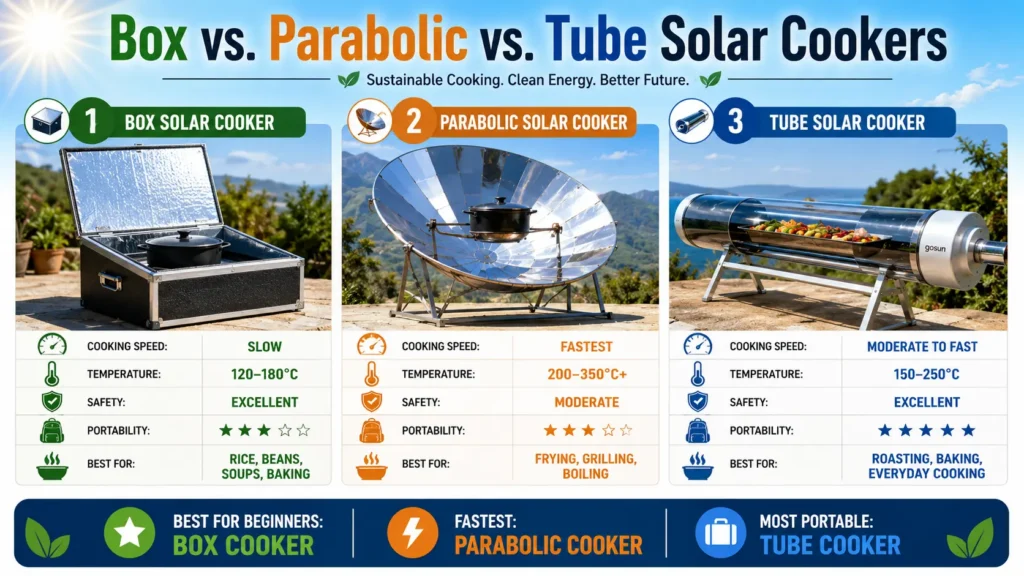
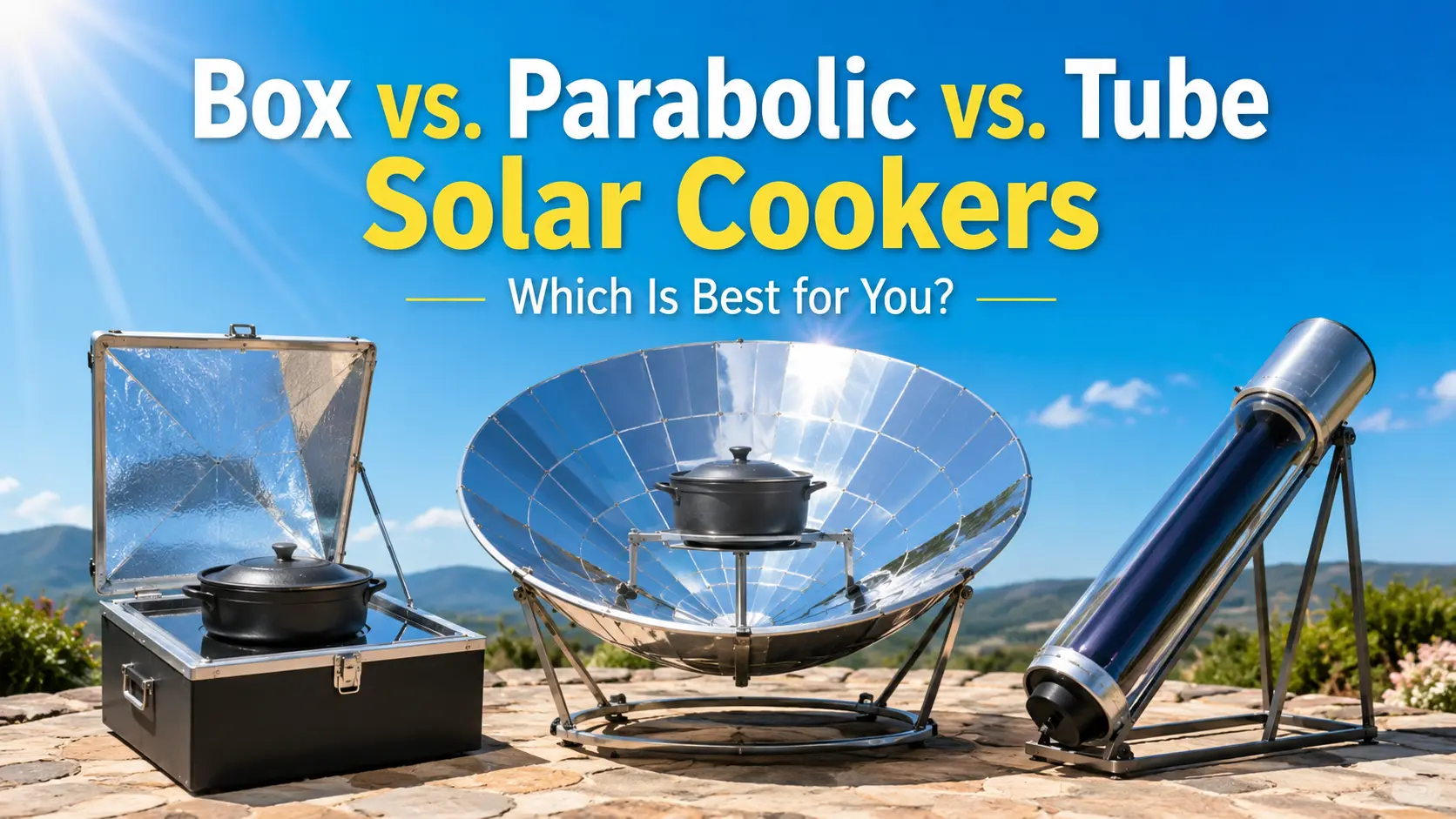
Solar cookers generally come in three dominant designs: Box Cookers, Parabolic Cookers, and Evacuated Tube Cookers. Each architecture interacts with thermodynamics differently, meaning each excels at totally different cooking styles, climates, and lifestyles.
If you’re looking to upgrade your solar cooking game or buy your first commercial unit, this definitive comparison guide will break down the physics, performance, and practical realities of all three designs to help you make an informed choice.
Table of Contents
Box vs. Parabolic vs. Tube Solar Cookers: Quick Comparison Table
| Feature | Box Solar Cooker | Parabolic Solar Cooker | Tube Solar Cooker |
| Cooking Speed | Slow to Moderate | Very Fast | Moderate to Fast |
| Max Temperature | 120°C – 180°C | 200°C – 350°C+ | 150°C – 250°C |
| Ease of Use | Very Easy | Requires Attention | Easy |
| Safety | Excellent | Moderate | Excellent |
| Portability | Moderate | Usually Large / Heavy | Very Portable |
| Wind Resistance | Good | Fair (Catches wind) | Excellent |
| Cold Weather Performance | Fair | Good (Needs direct sun) | Very Good (Insulated) |
| Best For | Beginners & Slow Cooking | Experienced Stovetop Chefs | Campers & Everyday Meals |
1. The Box Solar Cooker: The Reliable Slow Cooker
A box solar cooker consists of an insulated inner chamber covered by a transparent glass or plastic lid, usually surrounded by reflective panels that direct extra sunlight inward. Dark-colored, matte-finish pots sit inside, acting as heat sinks that absorb and retain the trapped thermal energy.
The Advantages
- Simple & Forgiving: It operates exactly like a kitchen crockpot. It’s incredibly beginner-friendly.
- Set-and-Forget Convenience: Because it relies on diffuse, trapped heat rather than a sharp focal point, it requires very little sun tracking. You can leave it for hours without worrying about burning your dinner.
- Massive Capacity: You can easily fit multiple pots or a large baking dish inside simultaneously.
- Ultra-Safe: There are no blinding glare points or open fire hazards, making it excellent for backyard family projects.
The Disadvantages
- Lower Top Temperatures: It rarely exceeds 180°C, meaning it cannot sear, fry, or grill effectively.
- Slower Cook Times: A pot of beans or a roast will take a few hours, requiring you to plan your meals well ahead of time.
🎯 Best Uses: Perfect for whole-wheat bread baking, slow-cooked stews, soups, rice, grains, and root vegetables. If you value a gentle, “set it and forget it” routine, this is your baseline.
2. The Parabolic Solar Cooker: The High-Power Stovetop
A parabolic cooker uses a precisely curved, highly reflective dish to focus a massive footprint of sunlight onto a single, concentrated focal point. Your cooking pot sits directly on a support stand over this focal node.
The Advantages
- Intense Speed: It generates focused heat that can boil water in minutes, rivaling a traditional gas stovetop.
- Extreme High Heat: Capable of blasting past 300°C, allowing you to achieve true pan-searing and stir-frying.
- High Versatility: It’s the only solar design where you can actively sauté, flip pancakes, or grill meat in real-time.
The Disadvantages
- High Maintenance: Because the focal point shifts as the earth rotates, you must manually adjust and track the sun every 15 to 30 minutes.
- Safety Hazards: The concentrated beam can easily scorch clothes, singe skin, or cause eye strain if you don’t wear UV-rated sunglasses.
- Wind Sensitivity: The large dish can act like a sail on windy days, and open air can rob your pot of heat if it isn’t shielded.
🎯 Best Uses: Exceptional for high-temperature stir-frying, quick boiling, searing meats, and traditional open-pan frying. It is best suited for experienced enthusiasts who want to actively “chef” outdoors.
3. The Tube Solar Cooker: The Modern Thermos
Tube cookers (like commercial GoSun units) utilize an evacuated double-wall glass cylinder. The space between the outer and inner glass layers is a total vacuum, which acts as a near-flawless thermal barrier. Food is loaded into a long, dark metal tray that slides directly into the core of the tube.
The Advantages
- Unrivaled Thermal Efficiency: Because a vacuum cannot conduct heat, these units lose almost zero energy to the surrounding air. They will cook beautifully even in freezing, sub-zero winter temperatures or high winds.
- Highly Portable: Most tube designs fold up into compact, lightweight cases, making them the ultimate choice for travel.
- Fast & Consistent: They heat up rapidly, usually cooking a standard family meal in 30 to 45 minutes.
The Disadvantages
- Linear Cooking Space: The narrow, cylindrical shape means you cannot cook awkwardly shaped food (like a whole round loaf of bread or a whole chicken) without cutting it down to fit the tray.
- Fragility: The heart of the unit is glass. While durable, it requires careful handling during transit and cleaning.
🎯 Best Uses: Ideal for roasting meats, baking cylindrical quick-breads, roasting vegetables, and prepping one-pot meals. It is a favorite among campers, travelers, and urban residents with tight balcony spaces.
The Ultimate Head-to-Head Showdowns
Which Cooker Is the Fastest?
The Parabolic Cooker wins by a landslide. If your metric is how fast you can boil a liter of water, nothing touches a curved reflector.
- Parabolic: 10 – 20 minutes
- Tube Cooker: 20 – 40 minutes
- Box Cooker: 40 – 90 minutes
Which Cooker Is the Safest for Families?
The Box and Tube cookers tie for first. Both keep the thermal energy safely enclosed inside an insulated chamber. Parabolic cookers feature an exposed, hyper-concentrated beam of light that requires a cautious workspace, safety perimeter, and eye protection.
Which Performs Best in Bad Weather?
The Tube Cooker is the undisputed champion of cold climates. Because its vacuum insulation shrugs off freezing ambient temperatures and biting winds, it only needs a clear window of bright sunlight to reach full baking power—even on a snowy winter afternoon.
🛠️ Pro Engineering Tips for All Solar Cooks
No matter which design path you choose, you can drastically boost your thermal efficiency by focusing on the materials you pair with them:
- Ditch the Shiny Cookware: Never use reflective stainless steel or aluminum pots inside a box or parabolic cooker. They bounce the sun’s rays away. Always opt for thin, matte-black enamelware or seasoned cast iron to absorb maximum energy.
- Master the Shadow Tracking Method: When aligning your cooker, look at the shadow cast by the frame. Adjust your cooker’s tilt and rotation until its shadow is perfectly small, tight, and symmetrical. When the shadow disappears under the unit, your tracking angle is flawless.
Final Thoughts: Finding Your Solar Fit
Ultimately, choosing a solar cooker is less about finding the “perfect” machine and more about matching your personal rhythm and cooking philosophy.
If you love the ritual of slow cooking—prepping a rich soup or stew in the morning, setting it out on the patio, and letting the afternoon sun gently meld the flavors while you work on other projects—a Box Cooker is a deeply satisfying, budget-friendly companion. If you love the high-energy, hands-on dynamics of traditional stovetop frying, the raw power of a Parabolic Cooker is unmatched. And if you are an active adventurer who wants a rugged, ultra-efficient piece of engineering that bakes a meal in the freezing cold or on a windy beach, a Tube Cooker is worth every penny.
Whichever path you choose, you are stepping away from the utility grid and participating in a cleaner, greener lifestyle—one delicious, sun-baked meal at a time.
❓ Frequently Asked Questions (FAQ)
Which solar cooker design is easiest to build as a DIY project?
The Box Solar Cooker is by far the easiest and most practical design to build at home. It can be made using simple household materials like cardboard boxes, aluminum foil, and a sheet of glass or plastic wrap. Because it relies on trapping heat rather than focusing light, the geometry doesn’t have to be perfect to work. Building a functional Parabolic or Tube cooker at home requires highly precise curves or specialized glassblowing, making them much harder to DIY.
Is a Parabolic cooker worth the extra cost over a simple Box cooker?
Yes, but only if you want to fry, sauté, or boil water quickly. If your cooking style involves stir-fries, searing meats, or quick outdoor meals, a box cooker cannot do the job, making a Parabolic cooker worth the investment. However, if you prefer low-maintenance, hands-off baking and slow-cooked stews, a basic Box cooker is actually the better, more convenient choice.
Why are Tube solar cookers more expensive than Box cookers?
The price difference comes down to materials and manufacturing technology. Tube cookers rely on industrial-grade evacuated glass tubes (similar to advanced solar water heating systems). Creating a perfect vacuum between two layers of glass requires high-tech manufacturing. While more costly, this vacuum technology is what allows the Tube cooker to cook circles around a Box cooker on cold, windy, or slightly overcast days.
Which design takes up the least space for camping or traveling?
The Tube Solar Cooker is the undisputed champion of portability. Most commercial models feature reflective metal wings that fold inward, transforming the entire unit into a compact, sleek carrying case that slides easily into a backpack or car trunk. Parabolic cookers require large, rigid dishes that are awkward to transport, and Box cookers tend to be bulky and cumbersome to pack.
If I can only buy one solar cooker for everyday household use, which type should I choose?
For the average household, a Tube Solar Cooker offers the best all-around versatility and convenience because it cooks relatively fast (30–45 minutes) and works reliably in any season. However, if you have a large family and regularly cook bulky meals, a large Box Cooker is a better fit due to its massive interior capacity.
Have more questions about solar cooking?
Visit our Solar Cooker FAQ: 50 Frequently Asked Questions for expert answers on choosing a solar cooker, cooking times, food safety, recipes, maintenance, and troubleshooting. It’s a great resource for both beginners and experienced solar cooking enthusiasts.