Cooking is an essential part of daily life, but the method you choose can affect cost, safety, and environmental impact. Traditional cooking methods such as gas stoves, electric cookers, and charcoal are widely used, while solar cookers offer an alternative that uses sunlight as a free energy source.
This guide compares solar cookers with traditional cooking methods in terms of cost, safety, and efficiency, helping you understand which option is more suitable for your needs.
What Is Solar Cooking?
Solar cooking uses sunlight to generate heat for cooking food. If you’re new to this method, you can start with Solar Cooker Basics to understand how it works in simple terms. Instead of fuel or electricity, solar cookers rely on reflective surfaces, heat absorption, and insulation to trap and maintain heat.
Common types of solar cookers include box cookers, panel cookers, and parabolic cookers. You can learn more about these designs in Types of Solar Cookers Explained.
What Is Traditional Cooking?
Traditional cooking methods use external energy sources such as:
- Gas stoves
- Electric cookers
- Charcoal or wood fires
These methods provide consistent heat and are widely used for everyday cooking due to their reliability and speed.
Cost Comparison
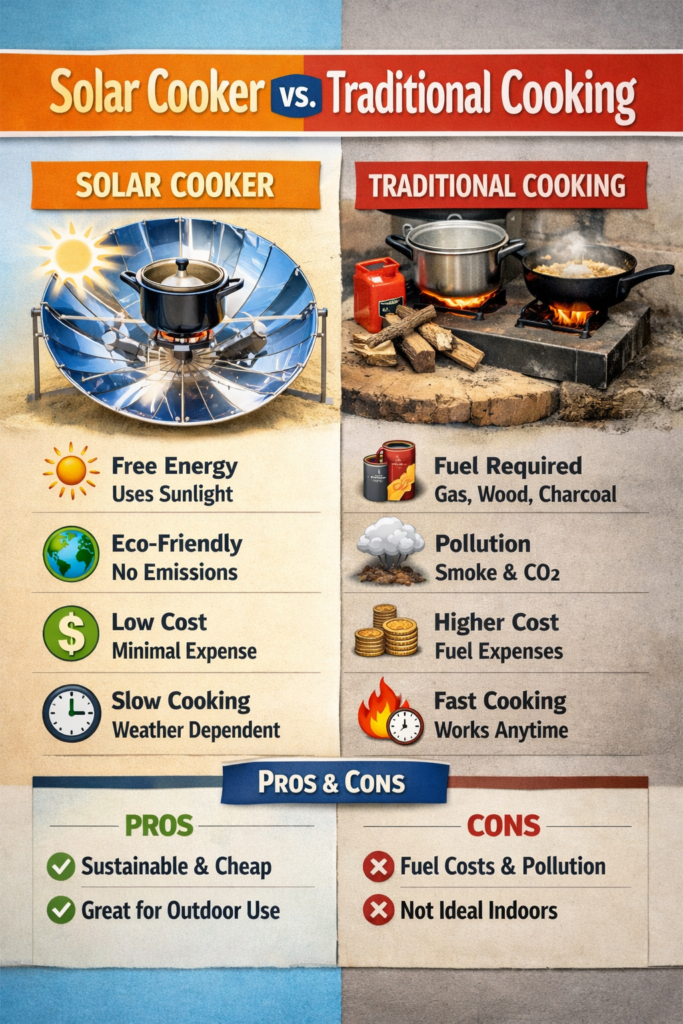
Solar Cooker
- No fuel or electricity cost
- Low operating cost after initial setup
- Can be built using simple materials (DIY)
Traditional Cooking
- Ongoing cost of gas, electricity, or fuel
- Prices may fluctuate over time
- Higher long-term expenses
Summary
Solar cookers and traditional cooking methods each have their advantages. For a more detailed breakdown, see Advantages and Disadvantages of Solar Cookers.
Safety Comparison
Solar Cooker
- No open flames
- No risk of gas leaks
- Lower risk of fire accidents
- Requires caution when handling hot cookware
Traditional Cooking
- Risk of fire or burns
- Gas leaks or electrical hazards
- Smoke exposure (especially with charcoal or wood)
Summary
Solar cookers are generally safer, particularly for outdoor use and in environments where fire hazards are a concern.
Efficiency Comparison
Solar Cooker
- Depends on sunlight conditions
- Slower cooking time
- Suitable for slow-cooked meals
- Limited performance in cloudy weather
Traditional Cooking
- Fast and consistent heating
- Works in all weather conditions
- Suitable for all types of cooking
Summary
Traditional cooking is more efficient in terms of speed and reliability, while solar cooking is effective when time is flexible and sunlight is available.
Environmental Impact
Solar Cooker
- Uses renewable energy
- No emissions
- Environmentally friendly
Traditional Cooking
- Produces emissions (especially wood and charcoal)
- Contributes to air pollution
- Uses non-renewable energy sources
Summary
Solar cooking has a significant environmental advantage due to its use of clean energy.
Real-World Example
In practical situations:
- A household in a sunny region may use a solar cooker for daytime meals to reduce fuel costs
- Traditional cooking may still be used for quick meals or during cloudy weather
Many users combine both methods for flexibility and convenience.
When to Use Each Method
Solar Cooker Is Best When:
- There is strong sunlight
- Cooking time is flexible
- You want to reduce fuel costs
Traditional Cooking Is Best When:
- Fast cooking is required
- Weather conditions are not suitable for solar cooking
- Precise temperature control is needed
Frequently Asked Questions
Is solar cooking cheaper than traditional cooking?
Yes, solar cooking has no fuel cost, making it cheaper in the long run.
Is solar cooking safe?
Solar cooking is generally safe because it does not involve open flames, but caution is still needed when handling hot cookware.
Is solar cooking efficient enough for daily use?
It can be effective in sunny conditions, but many people use it alongside traditional cooking for convenience.
Final Thoughts
Solar cookers and traditional cooking methods each have their advantages. Solar cooking offers low cost, safety, and environmental benefits, while traditional cooking provides speed, convenience, and reliability.
Understanding these differences helps you choose the best method based on your needs, environment, and cooking habits.
In many cases, using both methods together provides the most practical solution.