
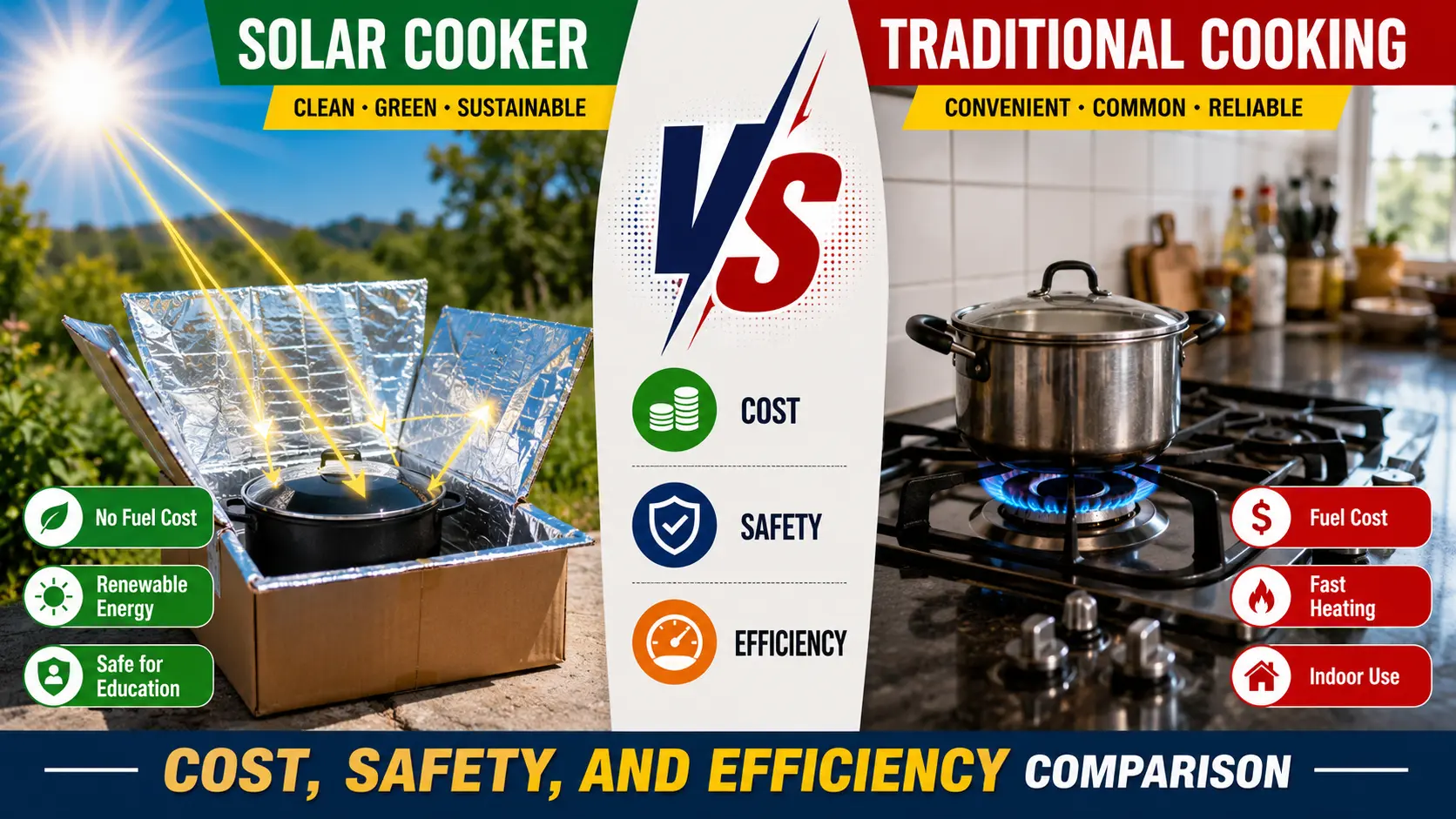
Solar cooker vs traditional cooking is an important comparison for anyone looking to save money, improve safety, and adopt a more eco-friendly lifestyle.
This guide compares solar cookers with traditional cooking methods in terms of cost, safety, and efficiency, helping you understand which option is more suitable for your needs.
If you’re looking for real product options, check out our updated guide to the best solar cookers in 2026 to compare top-rated models and prices.
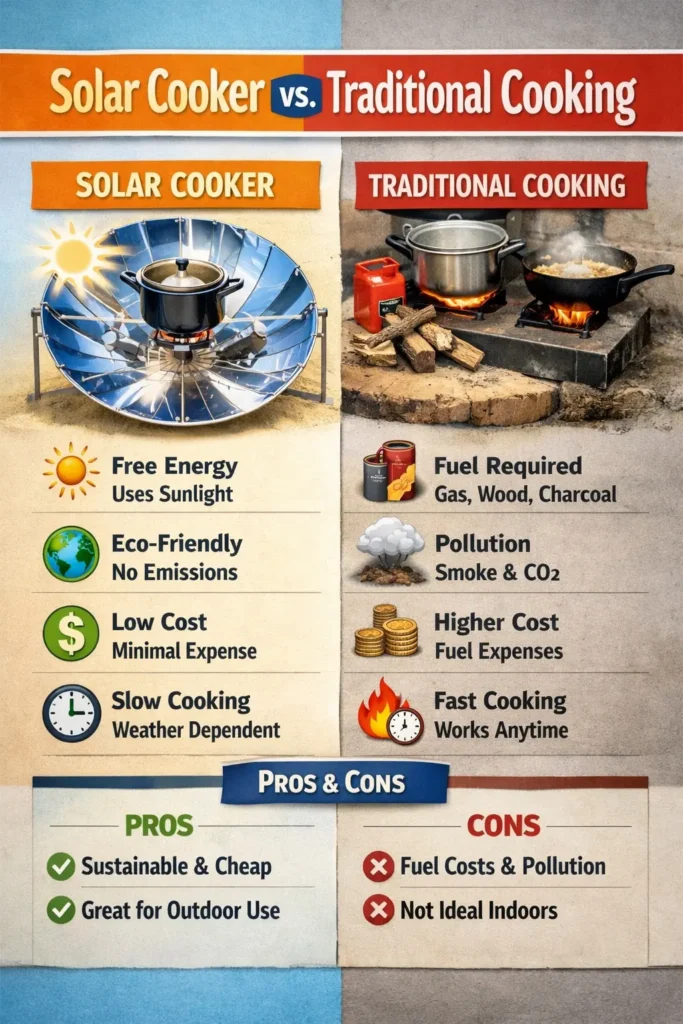
Solar Cooker vs Traditional Cooking (Overview)
| Feature | Solar Cooker | Traditional Cooking |
|---|---|---|
| Cost | Very low (free sunlight) | Ongoing fuel cost |
| Safety | No fire risk | Fire/gas risk |
| Speed | Slower | Faster |
| Environment | Eco-friendly | Pollution |
What Is Solar Cooking?
Solar cooking uses sunlight to generate heat for cooking food. If you’re new to this method, you can start with Solar Cooker Basics to understand how it works in simple terms. Instead of fuel or electricity, solar cookers rely on reflective surfaces, heat absorption, and insulation to trap and maintain heat.
Common types of solar cookers include box cookers, panel cookers, and parabolic cookers. You can learn more about these designs in Types of Solar Cookers Explained.
What Is Traditional Cooking?
Traditional cooking methods use external energy sources such as:
- Gas stoves
- Electric cookers
- Charcoal or wood fires
These methods provide consistent heat and are widely used for everyday cooking due to their reliability and speed.
Cost Comparison
Solar Cooker
- No fuel or electricity cost
- Low operating cost after initial setup
- Can be built using simple materials (DIY)
Traditional Cooking
- Ongoing cost of gas, electricity, or fuel
- Prices may fluctuate over time
- Higher long-term expenses
Quantifying Lifetime Fuel Savings and Thermal Efficiency
To evaluate the true economic contrast between solar cookers and traditional utility-based appliances, it helps to look beyond initial purchase prices and analyze operational fuel consumption. Standard electric ovens consume between 2,000 W and 5,000 W of power per hour, while propane stovetops burn liquefied petroleum gas (LPG) continuously at high hourly rates. Over a standard 10-year lifespan, conventional kitchen appliances accumulate hidden operational costs that frequently exceed five to ten times their original purchase price.
Conversely, a solar thermal collector operates with a zero-marginal-cost model. Once manufactured, the system captures radiant solar flux—delivering approximately 800 to 1,000 W/m2 of free peak thermal energy directly to your cookware. In regions with high utility electricity rates or volatile gas prices, a household using a solar cooker 3 to 4 times per week recovers the initial equipment cost within 12 to 18 months, converting all subsequent years of solar thermal harvesting into pure financial savings.
Summary
Solar cookers and traditional cooking methods each have their advantages. For a more detailed breakdown, see Advantages and Disadvantages of Solar Cookers.
Safety Comparison
Solar Cooker
- No open flames
- No risk of gas leaks
- Lower risk of fire accidents
- Requires caution when handling hot cookware
Traditional Cooking
- Risk of fire or burns
- Gas leaks or electrical hazards
- Smoke exposure (especially with charcoal or wood)
Summary
Solar cookers are generally safer, particularly for outdoor use and in environments where fire hazards are a concern.
Efficiency Comparison
Solar Cooker
- Depends on sunlight conditions
- Slower cooking time
- Suitable for slow-cooked meals
- Limited performance in cloudy weather
Traditional Cooking
- Fast and consistent heating
- Works in all weather conditions
- Suitable for all types of cooking
Which Is Better?
When comparing solar cooker vs traditional cooking, the better option depends on your needs. Solar cookers are ideal for saving money and protecting the environment, while traditional cooking offers speed and convenience. For long-term savings and sustainability, solar cooking is often the better choice.
The Hybrid Kitchen: Balancing Modern Speed with Natural Energy
Finding the balance between solar and traditional cooking is less about choosing a “winner” and more about building a smarter, more resilient kitchen. In my experience, these two methods don’t have to compete; they actually complement each other beautifully. There is a certain peace of mind that comes from knowing you have a reliable way to prepare a hot meal even if there’s a power hike or a fuel shortage. By integrating solar cooking into your routine, you aren’t just saving a few dollars on the utility bill—you’re diversifying your energy sources and taking a practical step toward self-sufficiency.
The real shift happens when you stop seeing the slower pace of solar as a “disadvantage” and start seeing it as an opportunity for better time management. While my traditional stove is there for the quick morning coffee or a late-night stir-fry, the solar cooker handles the heavy lifting of the midday meal while I’m busy with other tasks. It’s about using the right tool for the right job: the high-speed precision of gas or electric when time is tight, and the gentle, free energy of the sun when the day allows. Adopting both doesn’t just change how you cook; it changes how you think about the resources we often take for granted.
Some of the top-rated solar cookers in 2026 are designed to be more efficient and user-friendly than ever before.
Environmental Impact
Solar Cooker
- Uses renewable energy
- No emissions
- Environmentally friendly
Traditional Cooking
- Produces emissions (especially wood and charcoal)
- Contributes to air pollution
- Uses non-renewable energy sources
Emissions Profiles: Solar Thermal vs. Fossil Fuel Combustion
The environmental distinction between these cooking modalities centers on life-cycle carbon intensity and indoor air quality:
- Biomass & Charcoal Combustion: Traditional wood or charcoal cooking fires release substantial quantities of particulate matter, carbon monoxide, and black carbon aerosol into the immediate environment. According to global environmental studies, indoor air pollution from open biomass combustion presents significant respiratory risks while contributing directly to localized deforestation and atmospheric carbon buildup.
- Grid Electricity & Propane (LPG): While electric stoves eliminate indoor smoke, their indirect carbon footprint depends heavily on local power grid infrastructure. If grid electricity relies on coal or natural gas power generation, a single hour of oven baking indirectly emits several pounds of carbon dioxide.
- Direct Solar Thermal Collection: Solar cookers generate zero direct greenhouse gas emissions, zero combustion byproducts, and zero particulate pollution during operation. Shifting long-duration boiling and braising tasks to solar collectors directly reduces household carbon footprints while maintaining clean indoor air quality.
Summary
Solar cooking has a significant environmental advantage due to its use of clean energy.
Real-World Example
In practical situations:
- A household in a sunny region may use a solar cooker for daytime meals to reduce fuel costs
- Traditional cooking may still be used for quick meals or during cloudy weather
Many users combine both methods for flexibility and convenience.
There are several designs available, and you can explore the different types of solar cookers to find one that suits your cooking needs.
When to Use Each Method
Solar Cooker Is Best When:
- There is strong sunlight
- Cooking time is flexible
- You want to reduce fuel costs
Traditional Cooking Is Best When:
- Fast cooking is required
- Weather conditions are not suitable for solar cooking
- Precise temperature control is needed
Final Thoughts
Solar cookers and traditional cooking methods each have their advantages. Solar cooking offers low cost, safety, and environmental benefits, while traditional cooking provides speed, convenience, and reliability.
Understanding these differences helps you choose the best method based on your needs, environment, and cooking habits.
In many cases, using both methods together provides the most practical solution.
Frequently Asked Questions
Is solar cooking really cheaper than traditional methods when you consider the initial cost?
While a high-quality solar cooker has an upfront cost, it typically pays for itself within one to two years depending on how often you use it. Unlike gas or electric stoves, which have a “hidden” lifetime cost through monthly utility bills, a solar cooker’s operating cost is effectively zero. For those who enjoy DIY projects, building a cooker from recycled materials can make the return on investment almost immediate.
Can solar cookers cook all food?
Most foods can be cooked, but it takes longer than traditional methods.
Is it safe to leave a solar cooker unattended while I do other things?
Solar cooking is generally safe because it does not involve open flames, but caution is still needed when handling hot cookware.
Is solar cooking efficient enough for daily use?
One of the greatest safety advantages over traditional cooking is that solar cookers (specifically box and panel types) are very difficult to “overcook” or burn food in. You don’t have to worry about a pot boiling over or a grease fire starting. You can safely go about your gardening or work, only returning every hour or so to give the cooker a quick turn toward the sun.
How does the flavor of solar-cooked food compare to traditional cooking?
Many users find that solar-cooked food tastes superior because it cooks at lower, more consistent temperatures. Since the heat is gentle and the container is usually sealed, the food doesn’t “dry out” as easily, and delicate flavors in vegetables and meats are preserved rather than being boiled away or scorched. It’s very similar to the results you would get from a high-end slow cooker.
What is the “efficiency” difference during the winter or in cooler climates?
Efficiency is actually more about light than heat. As long as you have clear, direct sunlight, a well-insulated solar cooker will work even in freezing ambient temperatures. However, because the days are shorter and the sun is lower in the sky during winter, your “cooking window” is smaller, and food may take slightly longer to reach temperature compared to a hot summer day.
Want to learn even more?
Before you go, visit our Solar Cooker FAQ: 50 Frequently Asked Questions for practical advice, helpful tips, and answers to the questions people ask most often.
Disclosure: As an Amazon Associate, I earn from qualifying purchases.