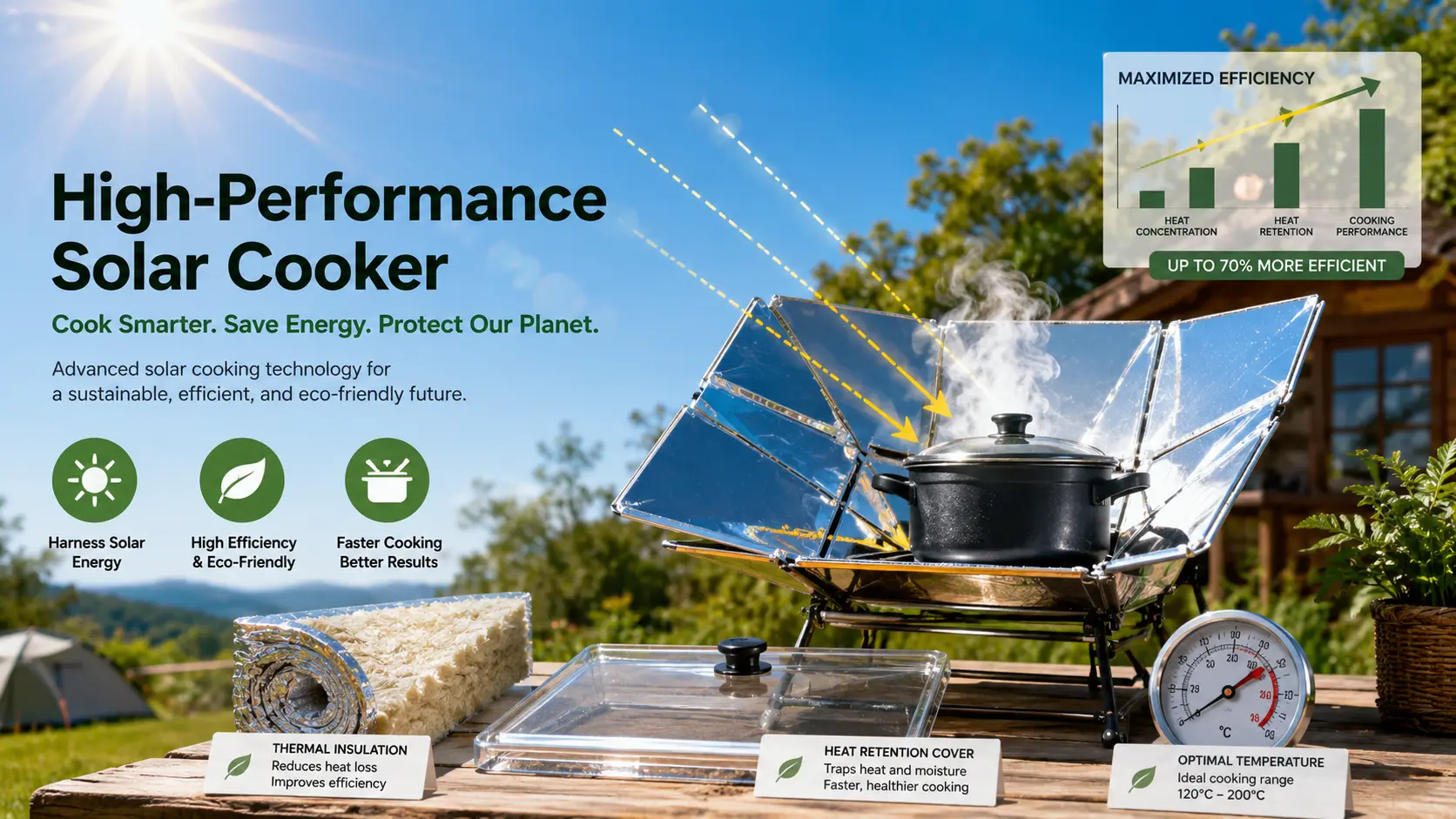
Knowing how to improve solar cooker efficiency is the secret to turning a slow, unpredictable outdoor experiment into a fast, reliable cooking method. By understanding how sunlight tracking, heat retention, and proper cookware selection work together, you can significantly boost your cooker’s performance without spending money on expensive new gear.
Improving solar cooker efficiency is not about buying expensive equipment — it’s about optimizing alignment, heat retention, and proper usage.
I still remember the first time I tried making a simple rice dish in my homemade box cooker. I set it out, walked away for two hours, and came back to a lukewarm, crunchy mess. It was incredibly frustrating! But that failed experiment taught me that solar cooking isn’t just “set it and forget it”—it’s a dance with the sun. Once I learned a few simple physics hacks, my cooking times dropped by half.
If your solar cooker is not heating properly or cooking too slowly, improving solar cooker efficiency can make a huge difference in performance and results. This guide explains practical ways to maximize performance.
Table of Contents
1️⃣ Adjust the Cooker Frequently
Sunlight moves constantly throughout the day.
Even if your solar cooker is properly aligned in the morning, it will gradually lose direct exposure as the sun shifts.
To improve efficiency:
✔ Re-align every 30–60 minutes
✔ Ensure no shadows fall inside the cooker
✔ Cook during peak sunlight (10:30 AM–2:30 PM)
Proper alignment alone can increase internal temperature noticeably.
For more on heating capability, see What Temperature Can a Solar Cooker Reach.
2️⃣ Use Dark, Thin Cookware
Dark surfaces absorb heat more effectively.
To improve efficiency:
- Use black or dark-colored pots
- Avoid shiny or reflective cookware
- Use thin metal pots for faster heat transfer
- Always cover pots with tight-fitting lids
Cookware selection directly impacts how quickly food heats up.
3️⃣ Improve Heat Retention
Solar cookers rely on the greenhouse effect to trap heat.
You can enhance heat retention by:
✔ Ensuring the glass or plastic cover seals properly
✔ Avoiding unnecessary lid opening
✔ Using wind protection
✔ Preheating the cooker before adding food
Opening the cooker too often releases accumulated heat and reduces efficiency.
Avoid common beginner errors by reviewing Common Solar Cooker Mistakes to Avoid.
4️⃣ Reduce Air Gaps and Leakage
Heat escapes through gaps in insulation.
If using a box solar cooker:
- Check seals around the lid
- Ensure insulation is intact
- Avoid warped covers
- Tighten reflector hinges
Better insulation means higher sustained cooking temperatures.
5️⃣ Use Reflective Surfaces Properly
Clean reflectors concentrate sunlight effectively.
To maintain performance:
- Wipe reflectors gently
- Avoid scratches
- Ensure reflector angle directs sunlight precisely into the cooking chamber
Even small alignment errors can reduce heat concentration.
Learn more about cooker designs in Types of Solar Cookers Explained.
6️⃣ Cook Smaller Portions
Large quantities of food slow down heat buildup.
Efficiency improves when:
✔ Using smaller portions
✔ Cutting food into smaller pieces
✔ Avoiding overfilling the cooking chamber
Solar cooking works best when heat can circulate evenly.
7️⃣ Shield from Wind
Wind lowers internal temperature by cooling the outer surfaces.
To reduce heat loss:
- Position the cooker in a sheltered area
- Use a wind barrier
- Place on stable, flat ground
Wind protection can significantly improve temperature stability.
Stopping Wind from Stealing Your Cooking Heat
Wind is one of the biggest hidden reasons solar cookers lose heat. Even on a bright, sunny day, a cool breeze passing over the glass lid or outer walls pulls warmth away from the cooking chamber. This is called convective heat loss, and it forces your solar cooker to waste energy constantly trying to warm back up instead of cooking your food.
Blocking the wind creates a protective bubble of still air around your setup. Setting up your cooker behind a simple wooden windscreen, inside a sheltered patio corner, or behind a folding cardboard barrier cuts down on heat loss instantly. Keeping the outer glass or plastic cover warm allows the inside of the cooker to reach higher cooking temperatures much faster.
8️⃣ Preheat Before Cooking
Just like a conventional oven, preheating improves results.
Allow 15–25 minutes of empty heating time before placing food inside.
This ensures:
- Faster cooking start
- Better temperature consistency
For cooking time expectations, read How Long Does a Solar Cooker Take to Cook Food.
☀️ Simple Shadow Alignment: Finding the Perfect Solar Angle
Aiming your solar cooker directly at the sun doesn’t require complex calculations—you just need to look at the shadow your cooker casts on the ground:
- The Zero-Shadow Rule: Position your solar cooker so that its side walls cast the smallest possible shadow on the ground. When the shadows behind the box or panel are as small and symmetrical as possible, the reflectors are aimed directly at the sun.
- Tracking the Seasonal Sun: Remember that the sun sits lower in the sky during winter months and higher during summer. Tilting the front of your cooker upward slightly during winter ensures that incoming sunlight hits the black bottom plate head-on rather than bouncing uselessly off the side walls.
- The 45-Minute Adjustment: Re-aiming your cooker every 45 minutes keeps sunlight focused squarely on your dark pot, raising internal temperatures by 15 degree C to 45 degree C compared to leaving the cooker in a fixed position all afternoon.
9️⃣ Choose the Right Solar Cooker Type
Efficiency varies by design:
- Box cookers: good insulation and steady heat
- Panel cookers: budget-friendly but slower
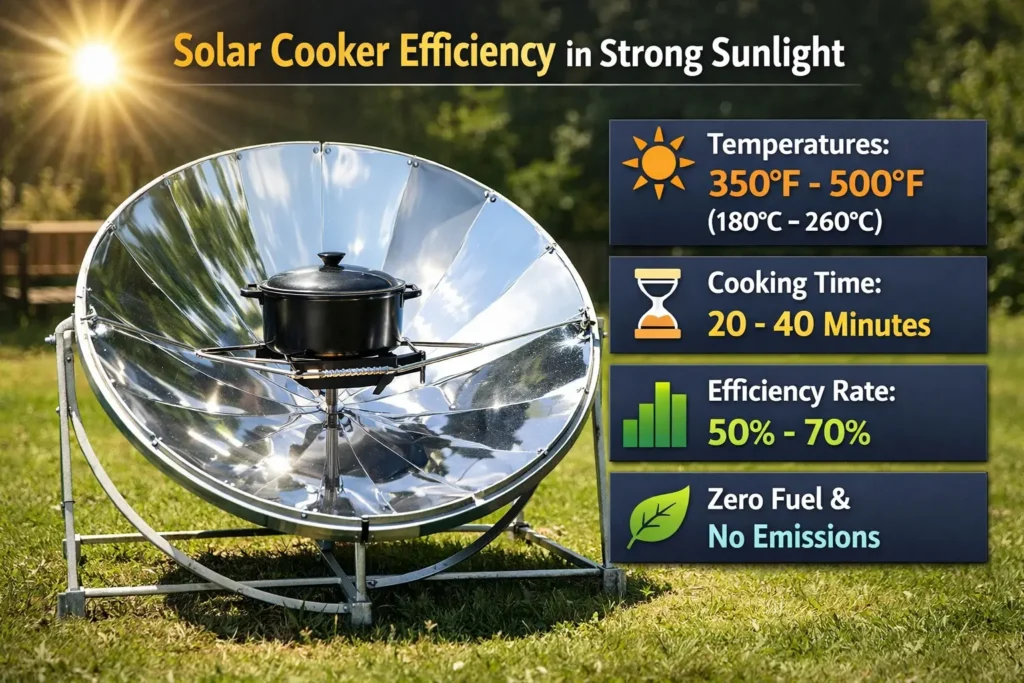
- Parabolic cookers: highest temperatures but require supervision
Selecting the appropriate design impacts performance directly.
10️⃣ Monitor Food Temperature
Using a simple cooking thermometer ensures food reaches safe internal temperature without unnecessary extended cooking time.
Solar cookers can cook meat safely when used correctly. Learn more in Can You Cook Meat in a Solar Cooker.
Many efficiency issues come from basic errors. Read our guide on common solar cooker mistakes to avoid these problems.
👉 Want better results? Check out the best high-efficiency solar cookers here.
Final Thoughts
Improving solar cooker efficiency is about optimizing sunlight exposure, insulation, cookware, and proper cooking habits.
Small adjustments — like re-aligning regularly or using dark cookware — can noticeably raise internal temperature and shorten cooking time.
With proper setup and practice, solar cooking becomes more reliable and consistent.
Frequently Asked Questions (FAQ)
1. How can I improve solar cooker efficiency quickly?
The fastest way to boost efficiency right now is to preheat your cooker for 20 minutes, switch to a thin, matte-black pot, and re-align the cooker directly facing the sun. Eliminating any drafts by taping up accidental air gaps also yields immediate results.
2. Why is my solar cooker cooking slowly?
Slow cooking is usually caused by three culprits: poor tracking of the sun, heat loss from wind or loose seals, or using the wrong cookware (like heavy cast iron or reflective stainless steel). If the ambient temperature is cold, your cooker also has to work harder against thermal loss, stretching out cooking times.
3. Does preheating a solar cooker help?
YYes, absolutely. Dropping cold food into a cold solar cooker drops the internal temperature of the chamber instantly, forcing the cooker to fight its way back up to temperature. Preheating for 15–30 minutes ensures that the chamber is already holding residual heat, allowing the food to begin cooking the moment you put it inside.
4. What type of cookware works best for maximum efficiency?
Always choose thin-walled, dark, matte metal pots (such as dark enameled granite ware or aluminum painted with high-heat, non-toxic black paint). Avoid heavy cast iron, as it requires too much thermal energy just to heat the pot itself. Also, steer clear of glass or shiny stainless steel, which reflect the sun’s rays away from the food.
5. Can I use a solar cooker in the winter or during cloudy weather?
Solar cookers rely on sunlight, not ambient outdoor heat, meaning you can absolutely solar cook on a freezing, sunny day in December. However, cloudy or hazy weather will significantly drop efficiency. While a specialized parabolic or vacuum-tube cooker might manage a slow simmer on a bright, overcast day, standard box and panel cookers will struggle to reach safe cooking temperatures without direct sunlight.
Can I use a regular oven baking bag to increase efficiency?
Yes! If you are using a panel cooker or a less-insulated homemade cooker, placing your dark cooking pot inside a clear, high-temperature oven baking bag creates an extra layer of insulation. It traps a pocket of hot air directly around the pot, acting like a double-pane window and drastically speeding up cooking times.
Looking for more solar cooking tips?
Our comprehensive Solar Cooker FAQ: 50 Frequently Asked Questions answers the most common questions about solar cookers, including how they work, cooking temperatures, food safety, cloudy weather, maintenance, and much more.