
If you’ve ever wondered why someone would swap a high-tech stove for a box and some sunshine, you’re in the right place. This guide breaks down the real-world benefits and the simple logic behind solar cooking.
At its core, a solar cooker uses the power of the sun to cook food without gas, electricity, or an open fire. It’s a clean, quiet, and remarkably effective way to prepare meals using renewable energy.
Whether you’re looking to lead a more sustainable life, save on rising fuel costs, or you just enjoy the “magic” of off-grid cooking, solar energy offers a proven, practical solution.
A solar cooker uses the power of sunlight to cook food without gas, electricity, or fire. It is a simple and environmentally friendly way to prepare meals using renewable energy.
At solarcooker.org, you’ll learn how solar cookers work, explore different types of solar cookers, and discover practical ways to use solar energy for everyday cooking.
Whether you are interested in sustainable living, off-grid cooking, education, or simply reducing fuel costs, solar cooking offers a realistic and proven solution.
🧭 The Role of Solar Thermal Technology in Modern Kitchens
Integrating solar thermal energy into your meal preparation represents a broader shift toward household energy resilience. While single-topic guides on solarcooker.org detail specific build instructions, cooking temperatures, and vessel selections, this hub serves as the main overview of how solar cooking fits into modern lifestyle setups.
Swapping conventional electrical appliances for direct radiant heat isn’t simply about reducing month-to-month utility costs—it redefines the daily cooking workflow. By transferring long-duration boiling, braising, and baking tasks to the daylight hours outside, households significantly reduce indoor heat gain during hot summer months, reducing the cooling load on home air conditioning units while eliminating carbon emissions at the source.
Start Here: Solar Cooking Guides
If you’re new to the world of solar cooking, these essential guides will get you up to speed:
Getting Started: Best Solar Cookers for Beginners
Solar Cooker Basics: What Is a Solar Cooker and How Does It Work?
Choosing Your Gear: Types of Solar Cookers Explained
These guides explain the core concepts clearly and help you understand how solar cookers work in real-world conditions.
Learn About Solar Cooking
Beginner Guides
Learn the fundamentals of solar cooking, including how solar cookers work, the different types available, and how to get started safely and effectively.
Cooking with Solar Cookers
Discover what foods you can cook, how long cooking takes, and how to improve performance under different sunlight conditions.
Tips, Safety & Limitations
Understand the practical side of solar cooking, including safety tips, common mistakes, and the limitations of solar cookers.
What You’ll Learn
At solarcooker.org, we focus on practical and realistic solar cooking knowledge. You’ll learn:
- How solar cookers work using reflection, absorption, and heat retention
- The differences between box, panel, and parabolic solar cookers
- What types of food can be cooked using solar energy
- Typical cooking times and temperatures
- How to improve solar cooking efficiency
- Safety tips and common mistakes to avoid
Our goal is to provide clear, useful information without exaggerated claims, so you can understand both the benefits and limitations of solar cooking.
What Is a Solar Cooker?
A solar cooker is a device that uses sunlight to generate heat for cooking food. It works by concentrating solar energy and trapping heat, allowing you to cook meals without electricity or gas.
👉 Learn more in our complete guide:
🔘 What Is a Solar Cooker (insert your internal link)
Why Use a Solar Cooker? Key Benefits
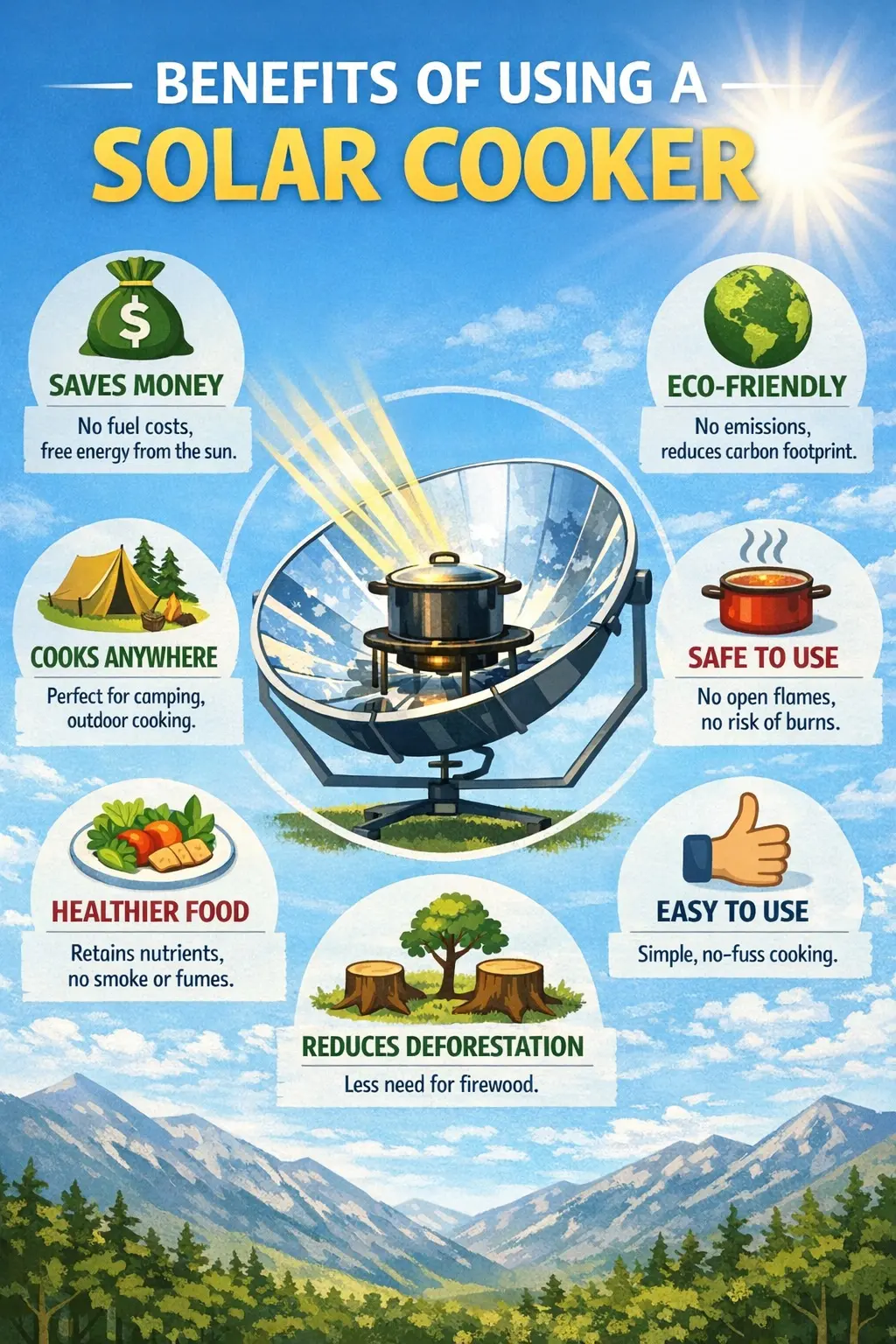
1. Save Money on Fuel
One of the biggest benefits of solar cooker use is cost savings. Since it uses sunlight, you don’t need gas, electricity, or charcoal.
2. Eco-Friendly Cooking
Solar cooking reduces carbon emissions and helps protect the environment. It’s a clean energy solution for sustainable living.
3. Cook Anywhere (Off-Grid)
You can use a solar cooker anywhere with sunlight — perfect for camping, outdoor cooking, and emergencies.
4. Safe and Low Risk
Solar cookers are generally safer than traditional stoves because they don’t use open flames or fuel.
5. Easy to Use
Most solar cookers are simple to set up and require minimal maintenance, making them beginner-friendly.
Benefits of Solar Cooker for Everyday Use
Using a solar cooker daily can help reduce energy bills and make cooking more sustainable. It is especially useful in sunny regions where sunlight is abundant.
Types of Solar Cookers
There are different types of solar cookers available, including box cookers, panel cookers, and parabolic cookers.
👉 Read more:
🔘 Types of Solar Cookers Explained (insert link)
How to Use a Solar Cooker
Using a solar cooker is simple:
- Place it under direct sunlight
- Adjust it to face the sun
- Use dark cookware
- Allow time for cooking
👉 Full tutorial:
🔘 How to Use a Solar Cooker
Solar Cooking Safety Tips
- Avoid direct eye exposure to reflected sunlight
- Use gloves when handling hot cookware
- Keep children away from high-heat models
👉 Learn more:
🔘 Solar Cooking Safety Tips
🎯 Primary Applications and Real-World Scenarios
To understand why someone would choose solar cooking over traditional gas or grid electricity, it helps to examine four distinct real-world application scenarios:
STEM & Educational Demonstrations: Educational institutions and science programs utilize basic panel and box cookers to provide tangible, hands-on demonstrations of thermodynamic principles, focal concentration, solar tracking, and renewable energy conversion.
Off-Grid Homesteading & Self-Reliance: For homes operating entirely on off-grid solar battery arrays, high-draw electrical kitchen appliances (like 1,500W electric ovens or induction cooktops) drain stored battery capacity rapidly. Using direct thermal solar cookers preserves electrical battery storage for nighttime lighting, refrigeration, and electronics.
Emergency Preparedness & Disaster Recovery: Following severe storms, grid failures, or natural disasters where municipal gas lines and power grids are severed, solar cookers provide an immediate, fuel-free method to pasteurize drinking water, sanitize utensils, and prepare hot, safe meals.
Eco-Conscious Outdoor Recreation: Campers and RV travelers using solar cookers eliminate the need to carry heavy, combustible propane canisters or gather dry firewood, respecting local seasonal burn bans while leaving zero trace in pristine outdoor environments.
Real-World Considerations
Solar cooking works best under strong, direct sunlight. In real conditions, factors such as weather, time of day, and cooker design can affect performance.
Cooking with solar energy usually takes longer than conventional methods, but it is well-suited for foods such as rice, beans, vegetables, and slow-cooked meals.
Understanding these practical factors helps you use solar cookers more effectively.
Explore More Solar Cooking Guides
You can explore more detailed guides below:
- What Foods Can You Cook in a Solar Cooker
- How Long Does a Solar Cooker Take to Cook Food
- What Temperature Can a Solar Cooker Reach
- Can You Cook Meat in a Solar Cooker
- How to Improve Solar Cooker Efficiency
- Advantages and Disadvantages of Solar Cookers
- Solar Cooker Safety Tips
- Common Solar Cooker Mistakes to Avoid
These articles provide deeper insights into real-world solar cooking and help you build confidence in using solar cookers effectively.
Frequently Asked Questions (FAQ)
Does a solar cooker work on cloudy days?
Solar cookers thrive in direct sunlight. While some high-efficiency models can trap heat on a hazy day, a thick cloud cover will significantly slow you down. Think of it as a “fair-weather” friend that works best when the skies are clear.
How long does solar cooking take?
Most meals take 1–3 hours depending on sunlight and food type.
Can you fry food in a solar cooker?
Yes, standard box and panel cookers are better for baking and stewing. If you want to fry an egg or sear meat, you’ll need a parabolic cooker, which concentrates heat into a single, high-temperature focal point.
Is the food safe?
Absolutely. As long as the food reaches the proper internal temperature. It is just as safe—and often more flavorful—than food cooked on a stove.