
Table of Contents
Introduction
Conducting a detailed solar cooker cost benefit analysis is the single best way to evaluate whether switching to solar thermal energy makes real financial sense for your household. With rising utility tariffs, fluctuating LPG tank prices, and growing interest in energy independence, calculating your expected payback period and return on investment gives you a clear financial roadmap.
In this detailed solar cooker cost benefit analysis, we break down the initial cost, operating savings, and payback period to help you decide whether switching to solar cooking makes financial sense.
💰 1. Initial Cost of a Solar Cooker
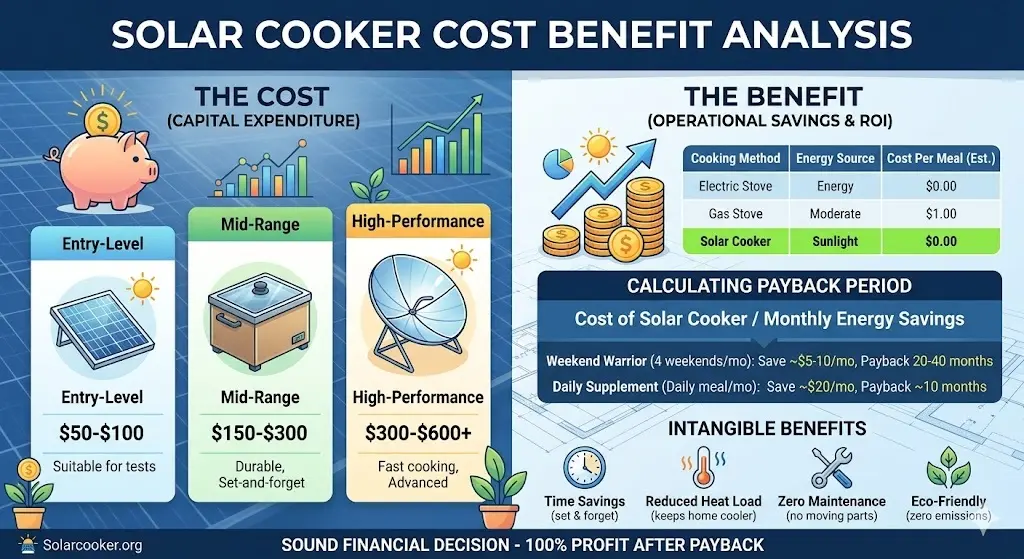
The upfront cost of a solar cooker varies depending on the type, size, materials, brand, and performance level. The following ranges are general examples rather than fixed market prices.
Typical Price Range:
- Entry-Level (Panel/DIY): $20 – $100
- Mid-Range (Box Cooker): $150 – $300
- High-Performance (Parabolic): $300 – $600
👉 Compared to gas stoves or electric appliances, the upfront cost may seem higher—but the real advantage comes from no direct fuel cost when cooking with sunlight
🔥 2. Operating Costs: Solar vs Conventional Cooking
The biggest benefit of a solar cooker is simple:
☀️ Sunlight is FREE
Cost Comparison Per Meal:
| Cooking Method | Energy Source | Direct Energy Cost |
|---|---|---|
| Electric Stove | Electricity | Varies |
| Gas Stove | LPG / Natural Gas | Varies |
| Solar Cooker | Sunlight | No direct fuel cost |
👉 This can reduce cooking energy costs, particularly for households that use a solar cooker regularly during suitable daylight conditions.
📉 3. Maintenance Costs
Solar cookers have very low maintenance requirements:
- No burners or gas leaks
- No electrical components
- Minimal wear and tear
Typical maintenance:
- Occasional cleaning
- Reflector replacement (after years)
👉 Compared with many conventional cooking appliances, solar cookers can have relatively low maintenance costs, although reflectors, glass components, or other parts may eventually require replacement.
⏳ 4. Payback Period (How Fast Do You Save?)
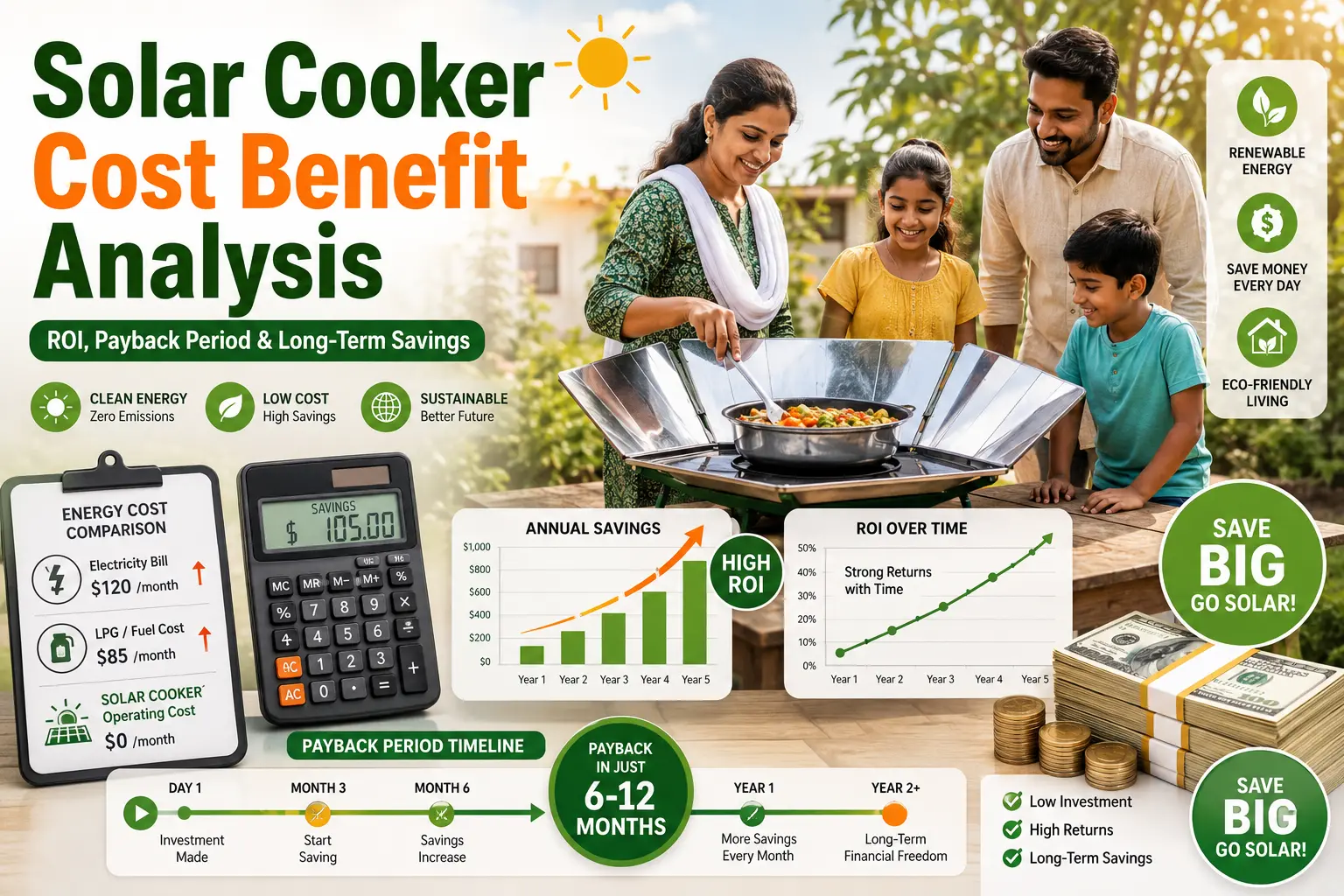
The payback period is the time it takes to recover your initial investment.
Example Calculation:
- Solar cooker cost: $200
- Monthly savings on gas/electricity: $15
👉 Payback period = 13–14 months
This is only an example. Actual payback will depend on the cooker price, frequency of use, local energy prices, and how much conventional cooking it replaces.
After the payback period, the direct energy savings can exceed the original purchase cost, although the cooker may still have maintenance, replacement, and other ownership costs.
Capital Expenditure (CapEx) vs. Operational Expenditure (OpEx)
From a quantity surveying and cost consulting standpoint, evaluating home appliances requires looking at total lifecycle cost (LCC) rather than just the initial price tag on the store shelf:
- Conventional Gas/Electric Stoves: These represent a low initial CapEx but a continuous, rising OpEx. Every time you turn on a gas burner or electric coil, you incur a recurring operational cost tied directly to utility rate hikes and fuel delivery fees. Over a 10-year lifespan, a conventional stove’s total cost is unpredictable and constantly climbing.
- Solar Thermal Collectors: Solar cookers generally have no direct fuel cost when operating on sunlight, although maintenance, repairs, replacement parts, and other ownership costs can still occur.
📊 5. Return on Investment (ROI)
Over a few years, the savings become substantial.
5-Year Example:
- Initial cost: $200
- Annual savings: $180
- Total savings (5 years): $900
👉 Net gain: $700
This example assumes the cooker consistently produces $180 in annual energy savings. Actual savings may be lower or higher depending on usage, weather, energy prices, and how much conventional cooking is replaced.
Under these assumptions, the solar cooker produces a positive financial return over five years.
🌍 6. Additional Benefits Beyond Cost
Solar cookers offer more than just savings:
✅ Environmental Benefits
- No direct combustion emissions during solar cooking
- Reduces dependence on fossil fuels
✅ Safety Advantages
- No open flame
- Can reduce some risks associated with open-flame cooking
✅ Energy Independence
- Not affected by electricity outages
- Ideal for rural or off-grid living
⚠️ 7. Limitations You Should Know
To be realistic, solar cookers also have some drawbacks:
- Depend on sunlight (not usable at night)
- Slower cooking time compared to gas
- Weather-dependent
👉 However, many users combine solar cooking with traditional methods for flexibility.
📊 Illustrative 5-Year Financial Comparison
To see how the numbers stack up over a typical 5-year appliance lifetime, consider this baseline operational estimate for a family cooking 4 meals per week during daytime hours:
These figures are illustrative estimates rather than universal market prices. Actual costs vary by country, appliance efficiency, energy tariffs, cooker price, and cooking habits.
| Financial Metric | DIY / Panel Solar Cooker | Mid-Range Box Cooker | Standard LPG Gas Stove | Electric Oven / Cooktop |
| Initial Cost (CapEx) | $30 – $80 | $150 – $250 | $100 – $200 | $150 – $300 |
| Annual Fuel / Utility Cost | $0 | $0 | $120 – $180 | $180 – $300 |
| 5-Year Fuel Expenditure | $0 | $0 | $600 – $900 | $900 – $1,500 |
| 5-Year Total Cost of Ownership | $30 – $80 | $150 – $250 | $700 – $1,100 | $1,050 – $1,800 |
Under these illustrative assumptions, the solar cooker has a lower five-year energy cost than the gas and electric alternatives. The actual payback period will depend on how frequently the cooker is used and the local cost of conventional energy.
8. Is It Worth It in Malaysia?
If you’re in Malaysia, solar cooking is especially attractive:
- ☀️ Abundant sunlight year-round
- 📈 Rising electricity tariffs
- 🔥 High LPG costs
👉 This means Malaysia’s generally sunny climate can provide more opportunities for solar cooking than locations with fewer suitable daylight hours. However, actual savings still depend on weather, cooking habits, cooker performance, and local energy prices.
Living in Sri Damansara, Kuala Lumpur, we are in a prime position to maximize this investment. With Malaysia’s abundant year-round sunlight, the “utilization rate” of a solar cooker is significantly higher here than in temperate climates. While a gas stove is a depreciating cost center, a solar cooker acts as a self-recovering asset. Whether you are boiling water or slow-cooking a meal, you are essentially generating a small, tax-free dividend in the form of energy savings, making it a very logical choice for the financially conscious homeowner.
🧠 9. Final Verdict: Is a Solar Cooker Worth It?
YES — It’s worth it if:
- You want to insulate your household from rising energy prices.
- You are looking for a high-ROI home improvement project.
- You enjoy eco-friendly, carbon-neutral living.
MAYBE — It’s a supplement if:
- You primarily cook late at night.
- You have very limited outdoor space or balcony access.
👉 Overall, the financial case for a solar cooker depends heavily on how often it is used, local energy prices, the initial purchase price, and the availability of suitable sunlight. For households that regularly cook outdoors during daylight hours, a solar cooker can provide meaningful energy savings. For others, it may be more practical as a supplementary cooking method rather than a complete replacement for conventional appliances.
Explore the followings for solar cooker cost benefit analysis
1. Different types of solar cookers such as box, panel, and parabolic designs offer varying levels of efficiency and cost.
2. A detailed comparison between solar cooker vs gas stove costs and efficiency shows where the real savings come from.
3. Choosing the best solar cooker design for home use can significantly improve cooking performance and savings.
4. Building a DIY solar cooker at home using simple materials is a low-cost way to start solar cooking.
❓ FAQ
Is a solar cooker worth the investment?
Yes, it can be worthwhile for households that use it regularly and have suitable sunlight. However, whether it is financially worthwhile depends on the initial cost, frequency of use, local energy prices, and the amount of conventional cooking it replaces.
How long does a solar cooker take to pay back?
There is no single payback period for every solar cooker. It depends on the purchase price, frequency of use, local fuel or electricity prices, and how much conventional cooking is replaced. For example, a $200 cooker saving $15 per month would take about 13 months to recover its initial cost.
Can a solar cooker fully replace a conventional gas or electric stove?
A solar cooker usually works best as a supplement rather than a complete replacement. It can handle suitable daytime cooking tasks such as boiling, stewing, baking, or slow cooking, while a conventional stove remains useful at night and during unsuitable weather.
What are the primary disadvantages or cost-tradeoffs of solar cooking?
When conducting a balanced cost-benefit analysis, you must factor in the following operational constraints:
Intermittent Resource: Performance is strictly dependent on real-time solar irradiance and weather conditions.
Time Dynamics: Slower thermal transfer means cooking times are generally longer compared to high-BTU gas burners.
Scheduling Constraints: Cooking operations must align with peak sunlight hours (typically 10:00 AM to 3:00 PM), requiring a shift in traditional meal preparation schedules unless using high-end models with heat storage capabilities.
Have more questions about solar cooking?
Visit our Solar Cooker FAQ: 50 Frequently Asked Questions for answers to common questions on choosing a solar cooker, cooking times, food safety, recipes, maintenance, and troubleshooting. It’s a great resource for both beginners and experienced solar cooking enthusiasts.