If you’re comparing a solar cooker vs solar oven, this guide explains the key differences, how each works, and which option is best for your needs.
For beginners, understanding different solar cooker types is important. See our guide to Types of Solar Cookers Explained.
Solar cooking is an environmentally friendly way to prepare food using the energy of the sun. Many people use the terms solar cooker and solar oven interchangeably, but they are not always exactly the same. Understanding the differences can help beginners choose the right device for their needs.
In simple terms, both solar cookers and solar ovens use sunlight to generate heat for cooking. However, the design, performance, and typical uses of each can vary.
This guide explains the key differences between solar cookers and solar ovens, how they work, and when each option is most suitable.
If you’re completely new to solar cooking, it may help to start with the fundamentals explained in Solar Cooker Basics.
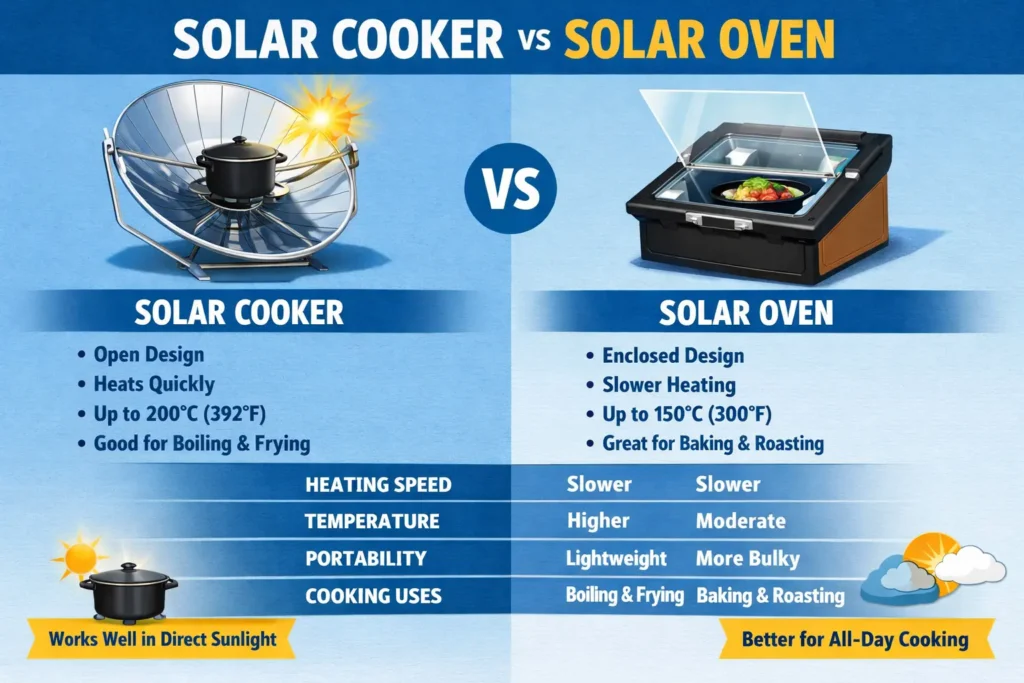
Table of Contents
Understanding the Semantic and Technical Distinction
In everyday conversations, backyard enthusiasts and off-grid homesteaders frequently use “solar cooker” and “solar oven” as interchangeable synonyms. However, from a mechanical and thermodynamic standpoint, there is a distinct difference in how these systems manipulate light waves and thermal energy.
The term solar cooker acts as an umbrella category encompassing every zero-emission appliance that relies on raw solar irradiance to heat food. This broader family includes simple fold-out panel designs, high-temperature parabolic dishes, evacuated solar glass tubes, and insulated box enclosures. Conversely, a solar oven refers explicitly to a specialized sub-category engineered around thermal containment. Rather than simply directing light at a pan, a solar oven functions as an insulated micro-greenhouse, capturing sunlight through a double-glazed or transparent aperture and holding high ambient temperatures inside a fully sealed chamber.
What Is a Solar Cooker?
Solar cookers usually work by combining three basic principles:
- Reflection – Mirrors or reflective surfaces concentrate sunlight onto the cooking area.
- Absorption – Dark cookware absorbs heat from sunlight.
- Heat retention – Insulation or covers help trap heat inside the cooker.
Common types of solar cookers include:
- Box solar cookers
- Panel solar cookers
- Parabolic solar cookers
Solar cookers are widely used for outdoor cooking, camping, educational demonstrations, and sustainable living.
Common types of solar cookers include box cookers, panel cookers, and parabolic cookers. You can learn more in our detailed guide to Types of Solar Cookers Explained.
What Is a Solar Oven?
A solar oven is a specific type of solar cooker designed to function more like a traditional oven. It uses insulation, a sealed cooking chamber, and reflective surfaces to trap heat and maintain consistent temperatures.
Solar ovens typically resemble a small insulated box with a transparent lid that allows sunlight to enter while preventing heat from escaping. This greenhouse-style design allows the oven to slowly build up cooking temperatures.
Solar ovens are especially useful for:
- Baking bread or cakes
- Cooking casseroles or stews
- Slow cooking foods evenly
Because of their insulated design, solar ovens often provide more stable cooking conditions than simpler solar cookers.
Key Differences Between Solar Cookers and Solar Ovens
Although the terms are sometimes used interchangeably, there are several differences between them.
| Feature | Solar Cooker | Solar Oven |
|---|---|---|
| General meaning | Broad category of solar cooking devices | A specific type of solar cooker |
| Cooking style | Can include many designs (panel, box, parabolic) | Typically box-style with insulation |
| Temperature stability | Depends on design | Usually more stable |
| Cooking speed | Some types cook faster (parabolic) | Generally slower, oven-like cooking |
| Typical uses | Outdoor cooking, experiments, camping | Baking and slow cooking |
In other words, a solar oven is a type of solar cooker, but not all solar cookers function exactly like ovens.
Thermodynamics: Open-Air vs. Insulated Heat Retention
The primary factor separating open solar cookers from dedicated solar ovens comes down to heat loss mechanisms: radiation, convection, and conduction.
Open-air solar cookers—such as panel cookers or parabolic focal dishes—rely heavily on continuous, uninterrupted direct solar beam radiation. A parabolic mirror concentrates intense light onto the base of a dark skillet, generating immediate surface heat. However, because the cooking container is exposed to ambient air, wind currents constantly pull heat away through air convection. This makes open panel and parabolic cookers highly vulnerable to light breezes, which can drop cooking temperatures rapidly.
Solar ovens eliminate convective heat loss through an engineered insulation boundary. When solar rays pass through the clear glass or polycarbonate lid, they hit dark interior absorber plates and cookware, converting shortwave light into longwave thermal infrared radiation. Because the longwave infrared heat cannot easily pass back out through the transparent lid, and because the side walls are lined with non-conductive insulation (such as rigid foam, fiberglass, or multi-ply reflective air barriers), the chamber traps heat. This trapped thermal mass allows a solar oven to maintain stable cooking temperatures between $225^\circ\text{F}$ and $300^\circ\text{F}$ ($107^\circ\text{C}$ to $149^\circ\text{C}$), even when intermittent clouds pass overhead or cold breezes blow across your backyard.
Which One Is Better for Beginners?
For most beginners, box-style solar ovens are often the easiest to use.
They are generally:
- Simple to operate
- Safer than high-temperature parabolic cookers
- Suitable for many common dishes
Panel cookers can also be beginner-friendly because they are lightweight and easy to build as DIY projects.
However, if faster cooking is important, some people prefer parabolic solar cookers, which can reach higher temperatures.
Evaluating Practical Cooking Style and Skill Level
Choosing between these two appliances often comes down to your cooking habits, patience, and safety expectations.
- Why Beginners Prefer Solar Ovens: Solar ovens offer a “set it and forget it” user experience similar to an electric crockpot or slow cooker. Because the enclosed chamber retains moisture and operates at moderate, steady temperatures, food rarely scorches, dries out, or burns—even if left unattended for an extra hour. This makes them exceptionally forgiving for first-time cooks who are learning how to track the sun.
- When an Open Solar Cooker Makes Sense: If you plan on taking your gear on lightweight backpacking or camping trips, carrying a heavy, rigid solar oven may not be practical. A foldable panel cooker or a compact evacuated tube cooker provides a much lighter, packable option that sets up in minutes, allowing you to boil water, prepare dehydrated meals, or cook basic grains on the trail.
What Foods Can Be Cooked Using Solar Cookers or Solar Ovens?
Both solar cookers and solar ovens can prepare a wide variety of foods under strong sunlight.
Common examples include:
- Rice
- Beans
- Vegetables
- Soups and stews
- Eggs
- Bread or baked dishes
Cooking time depends on sunlight intensity and the type of cooker used.
Many simple meals work well with solar cooking. You can see more examples in our guide to What Foods Can You Cook in a Solar Cooker.
Advantages of Solar Cooking
Solar cooking offers several benefits compared with traditional cooking methods.
Some of the most important advantages include:
- No fuel or electricity required
- Environmentally friendly cooking method
- Reduced air pollution from traditional fuels
- Useful in sunny climates or outdoor situations
Solar cookers are also often used in educational programs to demonstrate renewable energy and sustainability.
Limitations to Consider
Despite their advantages, solar cookers and solar ovens also have some limitations.
For example:
- They require strong sunlight to operate effectively
- Cooking can take longer than conventional stoves
- Performance may decrease in cloudy or rainy weather
Because of these factors, many people use solar cooking as a supplement to conventional cooking methods, rather than a complete replacement.
Final Thoughts
Solar cookers and solar ovens both harness the power of sunlight to cook food without traditional fuels. While the terms are often used interchangeably, solar ovens are usually a specific type of solar cooker designed to function more like a conventional oven.
Understanding the differences between these devices can help beginners choose the best option for their cooking style and environment.
Whether used for sustainable living, educational projects, or outdoor cooking, solar cooking offers a practical way to use renewable energy in everyday life.
FAQ
What is the difference between a solar cooker and a solar oven?
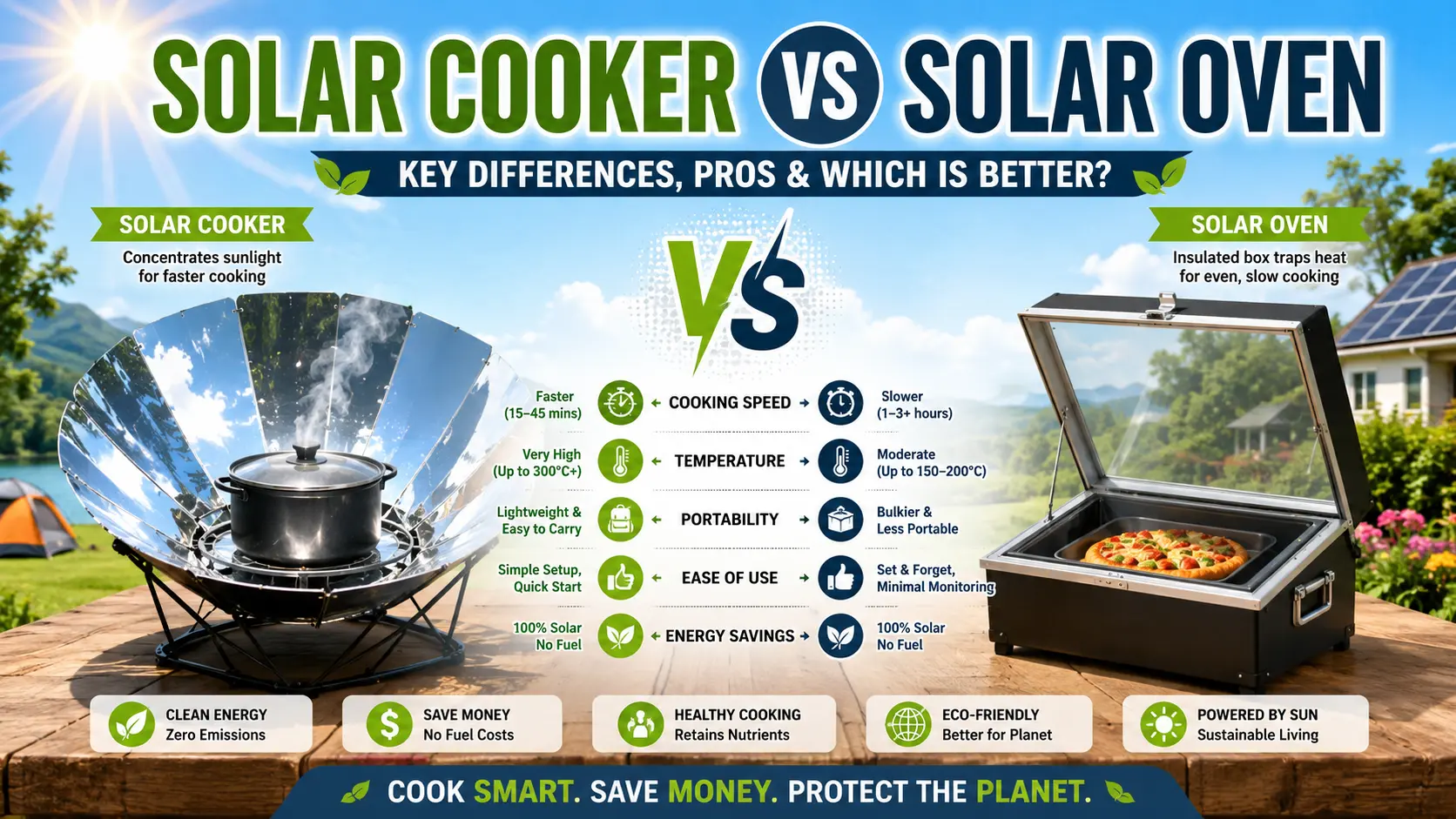
A solar cooker typically has an open design that uses reflective panels to focus sunlight directly onto the pot, allowing faster heating. A solar oven, on the other hand, has an enclosed structure with insulation and a transparent lid, which helps retain heat and cook food more evenly over a longer time.
Which is better: a solar cooker vs solar oven?
It depends on your needs. A solar cooker is better for quick heating and simple meals, especially in strong sunlight. A solar oven is more suitable for slow cooking, baking, and retaining heat, making it ideal for more complex dishes.
Can a solar cooker bake food?
Most basic solar cookers are not ideal for baking because they lack heat retention and consistent temperature control. However, some advanced designs can handle light baking. For reliable baking, a solar oven is the better choice.
Is a solar oven safer than a solar cooker?
Yes, in general, a solar oven is considered safer because it is enclosed, reducing the risk of burns and protecting the food from dust and insects. Solar cookers, with exposed reflective surfaces, require more careful handling.
Do solar cookers and solar ovens work on cloudy days?
Both devices rely on direct sunlight, so their performance drops significantly on cloudy days. Solar ovens may still retain some heat due to insulation, but neither is very effective without sufficient sunlight.
What foods can you cook in a solar cooker or solar oven?
You can prepare a variety of foods such as rice, vegetables, soups, stews, and even meats. Solar ovens can also bake bread, cakes, and cookies, while solar cookers are better for boiling and frying.
Which is more portable: solar cooker vs solar oven?
Solar cookers are usually lighter and more portable due to their simple, foldable design. Solar ovens tend to be bulkier because of insulation and enclosed construction.